
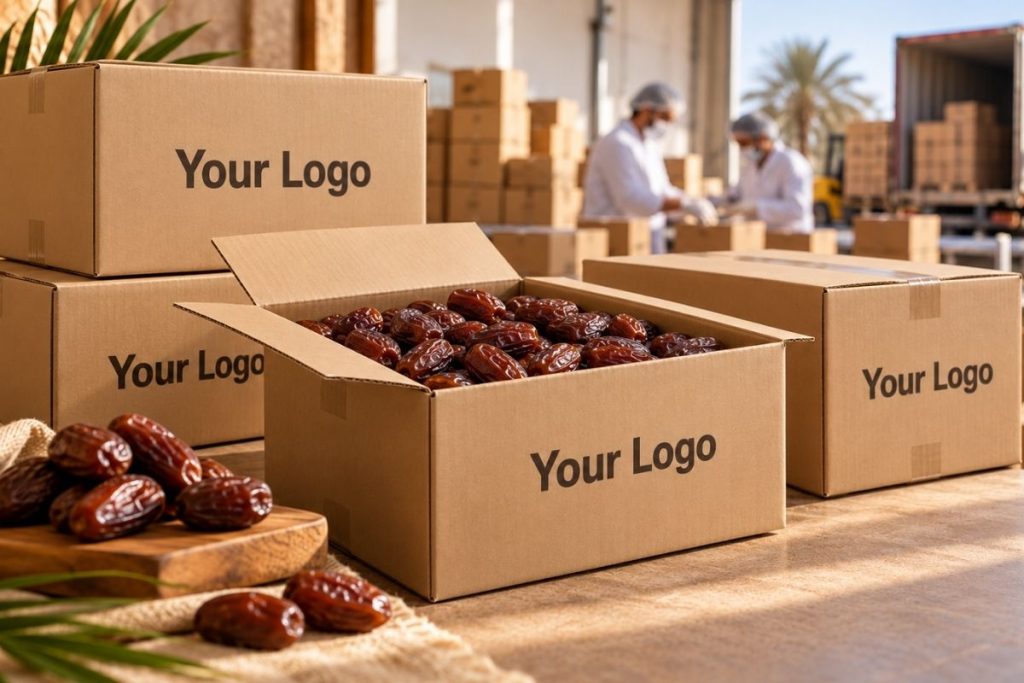
Choosing the right private label dates supplier is one of the most important decisions a retailer, distributor, importer or food brand can make when developing a private-label dates range.
The product itself matters, but private labeling involves much more than purchasing dates in bulk. Buyers must consider product specifications, grading, consistency, packaging, labeling, minimum order quantities, shelf life, logistics, pricing and regulatory requirements.
A supplier that can deliver an excellent sample but cannot maintain the same standard across commercial shipments can quickly become a problem. Likewise, an attractive price means little if packaging delays, inconsistent grading or documentation problems prevent the product from reaching retail shelves on schedule.
For retailers and distributors, the objective should therefore be clear: select a private label dates supplier capable of supporting both the product and the commercial process behind it.
This guide explains the key areas B2B buyers should evaluate before appointing a supplier, from choosing the right date variety and packaging format to calculating landed cost and approving final production.
Whether you are developing your first private-label dates product or expanding an existing portfolio, a structured sourcing process can reduce risk and create a stronger foundation for long-term growth.
What Is a Private Label Dates Supplier?
A private label dates supplier provides dates that are sold under the buyer’s own brand rather than the supplier’s consumer brand.
For example, a supermarket may source dates from a B2B supplier and sell them under its supermarket brand. A food distributor may create its own dates brand for independent retailers. An online grocery company may develop branded pouches specifically for e-commerce customers.
The same principle applies to wholesalers, specialty food companies, gifting businesses and regional distributors.
Depending on the arrangement, the supplier may provide the dates only, or it may support additional services such as sorting, grading, packaging, labeling, carton preparation and export documentation.
This is why buyers should understand exactly what is included before comparing quotations.
A low price for bulk dates cannot be compared directly with a quotation that includes consumer packaging, printed labels, master cartons and export preparation.
The complete scope must be clear.
Why Private Label Dates Are Attractive to Retailers and Distributors
Private labeling allows retailers and distributors to control more of the customer relationship.
Instead of competing only by selling established third-party brands, a business can create its own product positioning, packaging, price architecture and customer experience.
For retailers, this can help create differentiation.
If competing supermarkets stock many of the same brands, a well-developed private-label product gives the retailer something that customers cannot compare directly with another store.
For distributors, private labeling creates a different opportunity. Rather than supplying only commodity products, the distributor can build a recognizable brand that can be offered to supermarkets, groceries, wholesalers, food-service operators and e-commerce channels.
Dates are particularly suitable for this model because the category can support several positioning levels.
A buyer may develop an affordable everyday range, a premium retail line, a gifting product or multiple pack sizes targeting different customer groups.
However, successful private labeling depends heavily on supply consistency.
Brand equity belongs to the retailer or distributor. If the product disappoints customers, it is the buyer’s brand that receives the complaint.
That makes supplier selection especially important.
Private Label Dates Supplier vs. Bulk Dates Supplier
A bulk dates supplier and a private label dates supplier are not necessarily the same.
A bulk supplier may be perfectly capable of providing large quantities of dates in commercial cartons. However, private-label retail production requires additional capabilities.
The supplier must understand consumer packaging, artwork requirements, packaging dimensions, production tolerances, labeling, carton configurations, batch identification and delivery schedules.
Coordination also becomes more complex.
A normal wholesale order may involve agreeing on a grade, quantity, price and delivery date. A private-label order may require product samples, packaging selection, label artwork, legal information, barcode placement, print approval, production samples and final inspection before shipment.
Buyers should therefore ask suppliers about actual private-label capability rather than assuming that any bulk supplier can provide the same service.
Choosing the Right Date Variety for Your Private Label
The first product decision is the date itself.
Different varieties can deliver very different consumer experiences in terms of appearance, sweetness, texture, moisture level, size and price.
Maryam or Mariami dates, for example, are often considered by B2B buyers looking for an elongated appearance, pleasant texture and commercially attractive premium positioning.
Piarom dates can be considered for higher-end retail positioning where appearance and premium presentation are especially important.
Other varieties may suit different market segments, price points and customer preferences.
The correct choice depends on the customer you want to reach.
A discount supermarket may prioritize dependable quality and competitive price. A premium grocery chain may focus more heavily on appearance, size uniformity and packaging. A gifting brand may be willing to accept a much higher cost per kilogram in exchange for presentation.
Instead of asking a supplier simply for “the best dates,” buyers should define the required positioning first.
A good private label dates supplier should then be able to discuss which product specification best fits that positioning.
Specifications Matter More Than Product Names
A date variety alone is not a sufficient purchasing specification.
Two shipments carrying the same variety name can differ significantly.
Size, moisture, appearance, defects, texture, sorting and general consistency all influence how the final product is perceived.
For private-label buyers, these differences are particularly important because the customer expects the product to remain consistent every time they purchase it.
Before commercial production begins, buyer and supplier should therefore agree on a written product specification.
The specification should define the characteristics that matter for the intended product.
That may include variety, grade, size range, appearance, acceptable defect levels, moisture characteristics, packing format and net weight.
Commercial expectations should be measurable wherever possible.
Terms such as “premium quality” can mean different things to different companies. A more detailed specification reduces the possibility of disagreement when commercial shipments arrive.
The approved sample should also be connected to that specification.
Samples are useful, but written standards provide a better basis for repeated orders.
Product Consistency Is Critical for Private Labels
Consistency may matter even more than achieving the absolute highest grade available.
Retail customers develop expectations.
If a customer purchases a 500-gram package several times, they expect the product inside each package to look and taste reasonably similar.
Large changes in size, texture or appearance can weaken trust in the brand.
Distributors face the same challenge. Their retail customers need dependable products that can be reordered without unexpected differences.
When evaluating a private label dates supplier, ask how the supplier manages consistency between production batches.
The answer should go beyond simply saying that quality is controlled.
Buyers need to understand how specifications are communicated, how products are sorted or graded, what happens when the available crop varies and how the supplier handles a shipment that falls outside agreed standards.
This becomes increasingly important as order volumes grow.
A supplier may find it easy to prepare a small sample. Consistently producing commercial quantities is the more meaningful test.
Private Label Date Packaging Options
Packaging has a major influence on both cost and market positioning.
The same dates can be sold as an everyday grocery item or as a premium product depending on how they are presented.
Common concepts may include pouches, trays, boxes, tubs or premium presentation packs. The appropriate solution depends on the target market, pack weight, distribution channel and price point.
A retailer developing a high-volume supermarket SKU may prioritize efficiency, shelf visibility and straightforward case packing.
A premium food brand may place more emphasis on materials, finishes, structural packaging and presentation.
An e-commerce seller may need stronger packaging because products must survive individual parcel delivery rather than palletized retail distribution.
The packaging decision should therefore be made commercially, not only visually.
It must protect the product while supporting the intended price point.
Packaging Cost Can Change the Entire Business Case
Retail packaging costs can significantly affect the economics of a private-label project.
This is especially important when comparing different suppliers.
One quotation may include only the dates. Another may include the retail pack, printing, labels, cartons and packing labor.
Without separating these components, buyers can easily compare quotations incorrectly.
Packaging complexity also affects minimum quantities.
A generic pouch with a printed label may allow greater flexibility than fully custom printed packaging. Custom boxes, trays or pouches may require larger production quantities because packaging manufacturers frequently have their own minimum print runs.
That does not automatically make custom packaging a poor choice.
At sufficient volume, it can create stronger shelf presentation and lower the packaging cost per unit.
However, businesses launching a new SKU should balance branding ambitions with realistic sales forecasts.
It is often better to begin with a commercially manageable format, establish demand and then increase packaging customization as volume grows.
Understanding MOQ With a Private Label Dates Supplier
MOQ, or minimum order quantity, is one of the first commercial questions buyers usually ask.
But there can be more than one MOQ in private-label production.
The dates may have one minimum quantity. Packaging may have another. Printed boxes, pouches or labels may each have their own production requirements.
This means the effective MOQ is sometimes determined by packaging rather than the food product.
Buyers should also distinguish between MOQ per order and MOQ per SKU.
For example, combining several pack sizes or varieties in one purchase may be operationally different from ordering one product configuration in a larger quantity.
A reliable supplier should be able to explain these requirements clearly.
Retailers and distributors should avoid selecting pack formats before understanding the MOQ implications.
Otherwise, a design may be completed only to discover that the required packaging quantity is significantly larger than the expected first order.
Private Label Artwork and Branding
A private-label product needs more than an attractive logo.
Packaging artwork has both marketing and operational purposes.
The front of the pack must communicate the product effectively. The back or side panels often need to carry information required for retail sale and traceability.
Exact requirements depend on the destination market, product configuration and local regulations.
Depending on the market, information may include the product name, net weight, ingredient information where applicable, storage instructions, batch or lot information, production or expiry information, origin information, nutritional information and details of the responsible business or importer.
Language requirements must also be considered.
Retailers operating across several countries should not assume that the same packaging artwork can automatically be used in every destination.
Regulatory review should take place before packaging is printed.
A printing mistake may be inconvenient. A labeling compliance problem can prevent an entire shipment from being commercially usable.
Barcode and SKU Planning
Barcode planning should be completed early.
A 250-gram pack, a 500-gram pack and a 1-kilogram pack should therefore be treated as separate commercial products even when the same date variety is used.
This matters when artwork is created.
It also affects carton labels, inventory records, invoices, warehouse operations and retail listings.
If the buyer operates through multiple distributors or countries, product coding should be planned carefully before the first large packaging run.
Changing a barcode after thousands of packs have been printed is a costly mistake that can normally be avoided through early approval.
Food Safety and Documentation
Food safety documentation should be part of supplier selection rather than something requested only when the shipment is ready.
Buyers should determine what documents are required by their organization and destination market.
The exact requirements differ depending on country, channel and customer.
Large supermarkets may also have vendor approval procedures that exceed basic import requirements.
A capable private label dates supplier should communicate clearly about the documentation it can provide and the responsibilities of each party.
Do not assume that all documentation is automatically included.
Ask about certificates, product specifications, packing details, traceability documentation, shipment documentation and any market-specific requirements that may apply.
Where food-labeling or regulatory interpretation is required, buyers should confirm current requirements with the relevant destination-market authority or qualified compliance professional.
Shelf Life, Storage and Distribution
Dates can appear operationally simple compared with some food categories, but storage conditions still matter.
Product quality can change when food is exposed to unsuitable temperatures, excessive humidity or poor handling.
The correct storage conditions should therefore be agreed with the supplier and communicated throughout the distribution chain.
Retailers should consider how the product will move from supplier to warehouse, from warehouse to store and eventually to the consumer.
Distributors must consider an additional stage because products may spend time in their own warehouses before being sent to several customers.
Shelf-life planning should reflect this complete journey.
A long theoretical shelf life provides little benefit if a major portion of it has already been consumed by production delays, shipping, customs clearance and warehouse storage before the retailer receives the product.
Buyers should therefore discuss both total shelf life and minimum remaining shelf life at delivery.
How to Compare Private Label Dates Supplier Pricing
The lowest ex-warehouse price is not necessarily the lowest commercial cost.
Private-label buyers should evaluate the complete landed cost.
The calculation begins with the dates themselves but may also include packaging, printing, cartons, freight, insurance, customs costs, duties where applicable, documentation charges, warehousing and local delivery.
Retailers must then consider their own operating margin.
Distributors must normally account for both their margin and the margin required by the retailer or reseller.
Promotional discounts also matter.
If a supermarket expects regular promotional participation, the economics should be modeled before agreeing to a retail price.
Packaging waste, damaged stock and expiry risk can also affect the actual margin.
A product that appears highly profitable when only product cost is considered may become far less attractive once all channel costs are included.
This is why professional buyers evaluate total cost rather than only price per kilogram.
Private Label Dates Pricing Should Be Evaluated Per Pack
Retail buyers should also translate bulk pricing into cost per consumer unit.
Consider a simplified example.
If dates cost a certain amount per kilogram, a 500-gram retail pack does not simply cost half that amount.
The pack must also absorb packaging material, labels or printing, production handling, cartons, freight and other associated costs.
The final unit cost should then be compared with the expected wholesale or retail selling price.
This calculation makes it easier to compare different pack sizes.
A larger package may have a lower packaging cost per kilogram, while smaller packages may deliver a higher retail price per kilogram.
Neither strategy is automatically better.
The correct choice depends on consumer behavior, channel expectations and the desired positioning.
Samples and Pre-Production Approval
Samples should be used strategically.
The first sample normally helps the buyer evaluate the product.
Once the product specification is accepted, packaging development can move forward.
Before full commercial production, buyers should ideally approve the final configuration or an appropriate production reference.
The key principle is simple: avoid leaving major decisions until mass production has already begun.
Product, pack size, label, artwork and carton configuration should all be confirmed.
If several people are involved, approval responsibility should also be clear.
A supermarket buyer, brand manager, distributor and designer may all have different priorities. A formal approval process prevents conflicting instructions from reaching the supplier.
The Private Label Dates Supplier Workflow
A professional project generally moves through several stages.
The buyer first defines the target market, customer and price position. Product varieties and specifications are then reviewed. Samples are evaluated, followed by confirmation of the required grade and pack size.
The supplier and buyer then determine MOQ, packaging options and commercial pricing.
Artwork development follows once packaging dimensions and technical specifications are known.
Regulatory information, barcodes and final text should be checked before print approval.
A final quotation or purchase agreement should clearly identify the product, packaging, quantity, price, Incoterm or delivery basis, production expectations and payment terms.
Production then begins according to the agreed specification.
Before shipment, the relevant documentation and final quantities should be confirmed.
After the first delivery, performance should be reviewed.
This last stage is often ignored.
Feedback from stores, customers, warehouses and sales teams can help improve future production runs.
Private label should be viewed as an ongoing product program rather than a one-time purchase.
Retailers Need a Different Supplier Strategy Than Traders
Retailers must think about consumer behavior.
Shelf appearance, package communication, retail price, stock rotation and customer complaints all influence the private-label program.
A supermarket may also need predictable delivery windows because products are connected to promotions, planograms and distribution-center scheduling.
As a result, the cheapest supplier may not always create the best retail outcome.
Reliability can have measurable commercial value.
An item arriving several weeks late may miss a seasonal sales opportunity or promotional campaign. An inconsistent product may increase refunds or customer complaints.
For retailers, supplier evaluation should therefore include operational dependability alongside price.
What Distributors Should Look for in a Private Label Dates Supplier
Distributors face a slightly different challenge.
They must satisfy both their own requirements and those of their customers.
A distributor may supply supermarkets, independent groceries, wholesalers, hotels, restaurants or online sellers simultaneously.
That makes flexibility important.
Different customers may request different pack sizes, grades or price points.
Distributors should therefore consider whether a supplier can support growth across several product configurations.
They should also evaluate reorder capability.
Winning distribution for a product is valuable only if stock can be replenished reliably.
A distributor that develops a successful market but repeatedly runs out of product can damage relationships with retailers.
Planning production lead times and maintaining clear communication with the supplier becomes essential.
Private Label Quality Control
Quality control should begin before goods are produced, not after they arrive.
Clear specifications are the first layer of quality control.
Approved samples are the second.
Production and shipment checks then help confirm that commercial goods match expectations.
Buyers should define what will happen if products do not meet agreed specifications.
This does not require an unnecessarily complicated contract for every order, but responsibilities should be understood.
Photographs can support communication, but they should not replace clear product specifications.
Color and appearance can also look different depending on lighting, camera settings and screens.
For significant orders, buyers may consider independent inspection or testing when commercially appropriate.
The level of control should reflect the size, risk and requirements of the transaction.
Common Private Label Supplier Red Flags
Price should never be the only qualification criterion.
Warning signs include unclear specifications, frequent changes to commercial terms, inability to explain packaging requirements, inconsistent answers regarding MOQ, unclear production timelines and reluctance to document agreed details.
Another concern is excessive confidence without supporting information.
A supplier that says “everything is possible” without asking about destination market, pack size, volume or product specification may not fully understand the project.
Professional suppliers usually ask questions.
They need to know what the buyer is trying to achieve before recommending a suitable solution.
Communication during the sampling stage can also indicate what the future relationship may look like.
If basic questions require repeated follow-ups before an order has been placed, communication may become more difficult after production begins.
Do Not Select a Supplier Based on Samples Alone
An excellent sample is important, but samples represent only one part of supplier evaluation.
Buyers should also consider production capability, documentation, commercial communication, lead times and repeatability.
Ask whether the same specification can be supplied repeatedly.
Ask how seasonal differences are managed.
Ask what happens if the required grade becomes unavailable.
Ask how far in advance regular orders should be forecast.
A strong long-term supplier relationship depends on realistic planning from both sides.
The buyer should provide forecasts where possible, while the supplier should communicate constraints before they become urgent problems.
Private Label Packaging Should Support the Sales Channel
Packaging should be designed around where the product will actually be sold.
For supermarket shelves, visibility from normal shopping distance matters.
For wholesale channels, carton efficiency and competitive unit economics may be more important.
For online sales, the product may be seen first as a thumbnail on a smartphone screen. Branding and information must therefore remain recognizable at a small digital size.
For premium gifting, presentation becomes part of the product experience itself.
Trying to use one packaging concept for every channel can weaken the product.
Retailers and distributors developing several channels may benefit from a core brand architecture with different pack formats designed for specific use cases.
Build a Product Range Instead of a Single SKU
Once the first product is proven, private labeling can become a platform for a wider range.
A brand might begin with one core date variety and one popular pack size.
Later, it can introduce larger family packs, premium grades, alternative varieties or gift formats.
This approach reduces initial complexity.
Instead of launching many SKUs before understanding demand, the business can build around actual customer behavior.
Sales data from the first product can guide future decisions.
If customers frequently buy two smaller packs at once, a larger pack may make sense.
If premium varieties sell strongly during gifting periods, a seasonal presentation box may be worth testing.
The supplier relationship becomes more valuable when it can support this evolution.
How Much Should You Order for a First Private Label Project?
There is no universal answer.
The correct first order depends on MOQ, forecast demand, lead time, shelf life, warehouse space and working capital.
Businesses should avoid ordering solely on the basis that a larger quantity lowers the unit price.
Inventory carries risk.
If packaging is customized, slow-moving stock is also difficult to redirect to another customer.
A better approach is to estimate realistic monthly sales and understand the reorder timeline.
The first quantity should provide enough stock to support the launch without creating unnecessary exposure.
As sell-through becomes predictable, order quantities can increase.
A good private label dates supplier should be willing to discuss production planning rather than pushing buyers toward the largest possible opening order.
How to Prepare a Private Label Dates RFQ
A detailed request for quotation produces more useful quotations.
Instead of writing “Please quote dates,” provide the supplier with the intended variety or product type, estimated volume, destination country, required pack size, expected quality positioning and preferred packaging concept.
Also mention whether packaging already exists or must be developed.
If you have a target delivery date, include it.
If the project is intended for supermarkets or another specific channel, explain that as well.
These details allow the supplier to understand the project commercially.
The result is usually a much more meaningful quotation.
It also reduces the number of revisions required before both parties reach a final agreement.
Questions to Ask Before Appointing a Private Label Dates Supplier
Before placing the first commercial order, a buyer should be comfortable with the supplier’s answers regarding product specifications, available grades, consistency, MOQ, packaging options, artwork process, production lead time, storage recommendations, shelf life, documentation, shipping arrangements and payment terms.
Buyers should also understand who will be responsible for regulatory label approval.
Clarify what is included in the quoted price and what will be charged separately.
Ask how repeat orders work and whether packaging or labels must be held in inventory.
Discuss how price changes are communicated.
Finally, establish the primary person responsible for the account.
Clear communication can save significant time once regular orders begin.
Why Supplier Relationships Matter in Private Label
Private label sourcing works best when it becomes a long-term relationship.
The first order requires the most development work.
Specifications must be agreed. Artwork must be completed. Packaging must be selected. Operational expectations must be established.
Once these foundations are in place, repeat orders should become more efficient.
A supplier familiar with the buyer’s product, packaging and market can also provide more useful planning support.
This does not mean buyers should stop reviewing price or performance.
Performance should continue to be measured.
However, constantly switching suppliers solely to achieve a small short-term price difference may create hidden costs through new sampling, packaging changes, inconsistent quality and operational disruption.
Total commercial value matters more than a single price number.
Working With a UAE-Based B2B Trading Partner
For buyers serving the GCC and wider international markets, working with an established UAE trading partner can provide a practical commercial base for discussions, sourcing and export coordination.
The most important factor remains execution.
Retailers and distributors should evaluate whether their trading partner understands the requirements of professional B2B procurement, provides clear product information and responds effectively throughout the purchasing process.
At Shahin International Trading, discussions with B2B buyers can begin with the commercial requirements rather than a one-size-fits-all retail package.
Buyers can define their preferred date variety, target specification, quantity, packaging requirement, destination and expected channel.
From there, the objective is to develop a supply proposal that matches the intended market and commercial positioning.
For businesses comparing suppliers, this consultative approach can be especially valuable during the early stages of a private-label project.
Starting Your Private Label Dates Project With Shahin Trading
A private-label inquiry should begin with a few key pieces of information.
Tell the Shahin Trading team which market you intend to sell in, whether you are a retailer, distributor, wholesaler or food brand, which date varieties you are considering, your expected quantity and your preferred retail pack size.
If you already have packaging artwork, this can be reviewed as part of the discussion.
If the packaging has not yet been developed, provide examples of the positioning you are trying to achieve.
The more complete the initial brief, the easier it is to determine suitable product and commercial options.
Businesses can also request product specifications before moving toward a quotation.
For serious B2B projects, samples can then be evaluated before commercial requirements are finalized.
CTA: Request your private label dates specifications and quotation from Shahin International Trading.
Frequently Asked Questions About Private Label Dates Suppliers
What is a private label dates supplier?
A private label dates supplier provides dates that can be sold under the buyer’s own brand. Depending on the supplier’s capabilities and project agreement, services may include product selection, grading, retail packaging, labeling, carton preparation and export support.
What information should I send when requesting a private label quote?
Provide your required date variety or desired product positioning, estimated quantity, pack size, destination market, preferred packaging and target delivery period. The more complete the brief, the more accurately a supplier can prepare a quotation.
What is the typical MOQ for private label dates?
MOQ varies according to the product, packaging format, print requirements and supplier. In many projects, packaging requirements may determine the practical MOQ rather than the dates themselves.
Can I use my own packaging design?
Private-label projects normally involve the buyer’s own branding. However, packaging dimensions, materials, artwork format and labeling requirements should be confirmed with the supplier before final artwork is approved or printed.
What should retailers check before ordering private label dates?
Retailers should evaluate product specifications, consistency, packaging, landed cost, shelf life, labeling, documentation, lead time and the supplier’s ability to provide reliable repeat orders.
What should distributors prioritize?
Distributors should pay particular attention to reliable supply, reorder capability, pack-size flexibility, competitive landed cost and consistency across shipments. They should also consider whether the product provides sufficient margin for both the distributor and downstream retailer.
How should I compare quotations from different private label dates suppliers?
Compare like for like. Confirm whether quotations include only bulk dates or also retail packaging, labels, cartons, packing services and other charges. Evaluate total landed cost rather than comparing only price per kilogram.
Should I request samples before placing an order?
Yes. Samples are an important part of product evaluation. However, an approved sample should ideally be supported by a written product specification so future commercial shipments can be evaluated consistently.
Conclusion: Choosing the Right Private Label Dates Supplier
Selecting a private label dates supplier is not simply a matter of finding the lowest wholesale price.
The supplier becomes part of your brand’s supply chain.
Product quality, consistency, packaging, labeling, documentation, communication and delivery performance can all affect how customers experience your brand.
Retailers should choose suppliers that understand consumer-facing requirements and can support dependable replenishment.
Distributors should look for suppliers capable of delivering commercial flexibility, repeatable specifications and reliable supply as their customer base grows.
Start by defining your market, target consumer, product positioning, pack size and expected volume. Then evaluate suppliers against those requirements rather than adapting your business to whichever product happens to be available.
A strong private-label program should create value for every participant: the supplier, importer, distributor, retailer and ultimately the consumer.
For buyers currently developing a dates range, Shahin International Trading can discuss B2B requirements including product specifications, quantities, packaging requirements and commercial supply options.
Looking for a private label dates supplier? Request product specifications and a B2B quotation from Shahin International Trading today.