
Buying Piarom dates wholesale is very different from purchasing a few cartons of dates for retail consumption. For importers, distributors, wholesalers, supermarkets and private-label businesses, the commercial success of an order depends on far more than taste and appearance.
Size consistency, moisture, crop year, grading method, packaging, shelf life, defect tolerance, documentation, minimum order quantity and shipping terms can all affect the real value of a shipment.
Piarom dates are positioned in the premium segment of the international dates market. Their elongated appearance, dark color, semi-dry texture and distinctive eating quality make them particularly attractive for premium retail, gifting, specialty food stores and higher-value private-label programs.
However, the word “Piarom” alone is not a complete product specification.
Two suppliers may both offer Piarom dates while delivering noticeably different products in terms of size, appearance, moisture, sorting accuracy and packaging quality.
For professional buyers, the objective should therefore be simple: convert a general request for Piarom dates into a clear commercial specification that both buyer and supplier understand.
This Piarom dates wholesale guide explains how to do that.
We will cover product specifications, grading, packaging formats, MOQ considerations, quality-control procedures, export documentation, private labeling and a detailed buyer checklist you can use before requesting your next quotation.
What Are Piarom Dates?
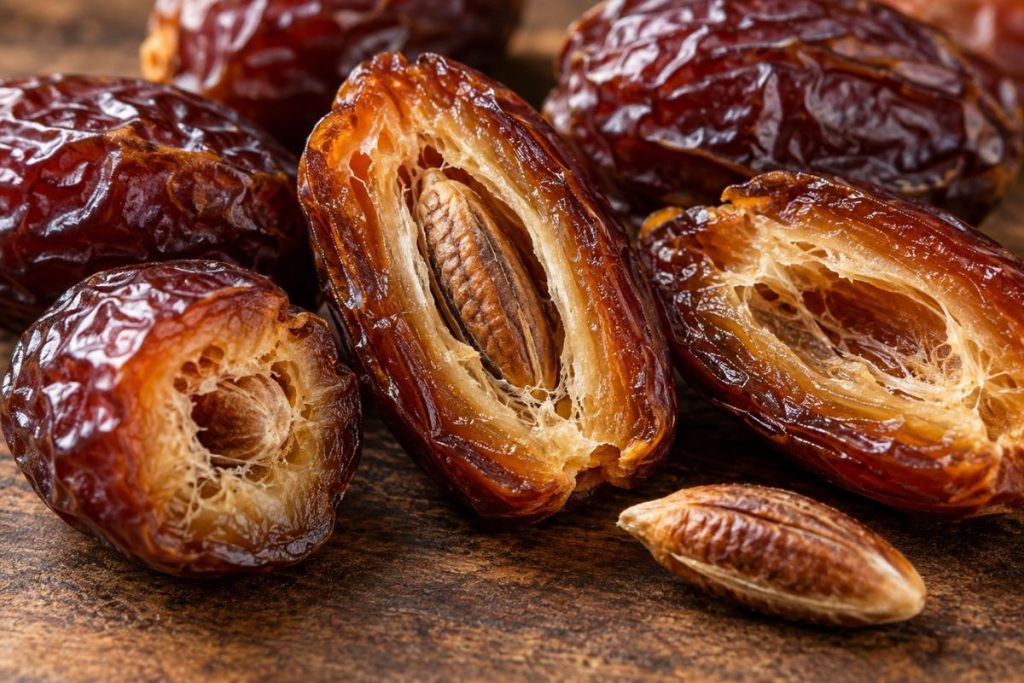
Piarom is a premium date variety known for its long, narrow shape, dark brown to near-black appearance and relatively firm, chewy texture.
It is generally classified commercially as a semi-dry date, which creates an important advantage for international distribution. Compared with very soft, high-moisture varieties, semi-dry dates can often be easier to handle, pack, transport and merchandise.
For B2B buyers, several characteristics contribute to Piarom’s commercial positioning:
- Premium visual appearance
- Elongated fruit shape
- Dark natural color
- Firm yet chewy eating texture
- Relatively low moisture compared with soft-date varieties
- Good suitability for premium retail presentation
- Strong potential for private-label packaging
- Convenient handling for international distribution
Piarom is typically sold whole and unpitted because the natural appearance of the fruit is an important part of its premium positioning.
The skin commonly sits closely against the flesh, although the level of skin separation can vary according to crop, processing, storage and grade.
Importantly, buyers should not assume that every shipment marketed as Piarom will have identical characteristics. Agricultural products naturally vary from crop to crop, and commercial grading standards can differ between suppliers.
That is why professional procurement begins with a written specification.
Piarom Dates Wholesale Specifications: What Buyers Should Define
When sourcing Piarom dates wholesale, your RFQ—or Request for Quotation—should contain more information than simply:
“Please quote Piarom dates.”
A more professional request defines the product in measurable commercial terms.
Here are the main specification points buyers should address.
| Specification | What the Buyer Should Confirm |
| Variety | Piarom |
| Style | Whole, usually unpitted |
| Crop Year | Current or specified harvest |
| Grade | Supplier grade plus measurable definition |
| Size | Count/kg, average weight or agreed sizing system |
| Color | Expected commercial color range |
| Texture | Semi-dry / agreed firmness |
| Moisture | Target or maximum percentage |
| Skin Separation | Acceptable tolerance |
| Defects | Maximum agreed percentage |
| Foreign Matter | Acceptable limit |
| Live Insects | None acceptable |
| Packaging | Retail or bulk configuration |
| Net Weight | Exact weight per unit/carton |
| Shelf Life | Supplier-declared period |
| Storage | Required storage conditions |
| Treatment | Any washing, sorting or processing |
| Food Safety | Applicable certifications/testing |
| Label | Buyer or supplier brand |
| Origin | Declared origin and documentation |
The more precisely these points are agreed before production, the less room there is for disagreement when the shipment arrives.
Do Not Buy Based on the Grade Name Alone
Terms such as:
Premium, Super, Super Select, Grade A, Jumbo, Extra Large or Luxury
may sound impressive, but they are not always universal specifications.
One supplier’s “Super” grade may be another supplier’s standard grade.
Professional buyers should therefore ask:
What measurable specifications define this grade?
For example:
- How many dates per kilogram?
- What is the average fruit weight?
- What moisture range applies?
- What defect percentage is tolerated?
- How much skin separation is acceptable?
- How uniform should the color be?
This allows you to compare quotations more accurately.
Piarom Dates Wholesale Size and Grading
Size is one of the most important commercial factors in premium dates.
Larger and more uniform fruit will generally command a different price than smaller or mixed-size fruit.
However, simply requesting “large Piarom” is not enough.
Use Count Per Kilogram Where Possible
A practical B2B method is to define size according to the approximate number of fruits per kilogram.
This approach gives buyers something measurable.
Generally:
Fewer dates per kilogram = larger average fruit size.
However, the exact count ranges used for commercial Piarom grades should be agreed directly with the supplier rather than assumed.
The Codex Standard for Dates also demonstrates why objective sizing can be useful. For unpitted dates generally, its optional classification defines large dates as fewer than 80 fruits per 500 grams, medium as 80–100 and small as more than 100. These are broad international date standards rather than Piarom-specific commercial grades, so buyers should still contract against the supplier’s exact specification.
A Better RFQ
Instead of writing:
“Need Super Piarom.”
Write:
“Please provide your Piarom grades with count/kg, average fruit weight, moisture specification, defect tolerance and photos for each grade.”
That immediately creates a better basis for comparison.
Moisture Content Matters in Piarom Dates Wholesale
Moisture affects several important characteristics:
- Texture
- Shelf stability
- Handling
- Packaging
- Storage requirements
- Appearance
- Perceived freshness
Piarom is generally traded as a semi-dry variety, but buyers should still request the moisture specification from the supplier.
International date standards also contain moisture requirements for commercially prepared dates. Codex specifies maximum moisture levels according to date type and composition, illustrating why moisture should be treated as a measurable quality parameter rather than a subjective description such as “dry” or “soft.”
For a commercial contract, request either:
Target moisture: for example, the supplier’s normal production range.
or:
Maximum moisture: the highest permitted value under your agreed specification.
The exact figure should come from the product specification and supplier documentation rather than from a generic online description.
Color, Appearance and Skin Quality
Piarom’s visual appearance is one reason it works well in premium packaging.
Professional buyers should evaluate:
Color Consistency
The dates should fall within the agreed natural color range for the grade.
Excessive variation can reduce the visual quality of a retail pack, especially when transparent trays or windows are used.
Skin Separation
The relationship between the outer skin and flesh affects appearance.
Ask suppliers to define the permitted level of loose or separated skin.
Shape
Premium retail grades normally benefit from better uniformity in length, width and overall appearance.
Surface Condition
The buyer should specify unacceptable conditions such as excessive cracking, fermentation, contamination, damaged fruit or other serious defects.
Foreign Material
The specification should also establish requirements regarding foreign matter and cleanliness.
Packaging Options for Piarom Dates Wholesale
Packaging decisions should be made according to the final sales channel.
A wholesaler supplying food-service operators has very different requirements from a supermarket importer launching a premium retail brand.
Common commercial formats can include retail packs from a few hundred grams up to approximately 1 kg, while bulk Piarom is also widely packed in larger cartons such as 5 kg and 10 kg. Exact formats vary between processors and suppliers.
1. Bulk Packaging
Bulk cartons are appropriate when the importer:
- Repacks locally
- Supplies wholesalers
- Supplies food service
- Operates its own packing facility
- Wants a lower packaging cost
Typical commercial formats may include:
5 kg cartons
10 kg cartons
The inner food-contact packaging is equally important.
Buyers should confirm:
- Inner liner material
- Food-grade compliance
- Carton strength
- Net weight
- Gross weight
- Carton dimensions
- Number of cartons per pallet
- Pallet dimensions
- Pallet net and gross weight
These details directly affect freight calculations.
2. Retail Packaging
For premium retail distribution, Piarom can be offered in smaller consumer packs.
Formats may include:
- Trays
- Window boxes
- Pouches
- Sleeves
- Rigid premium boxes
- Gift-style packaging
Possible weights include approximately:
200–250 g
400–500 g
1 kg
The right pack size depends heavily on your market.
A premium grocery chain may prefer 250 g or 400 g packs, while a value-focused supermarket could prefer 500 g or 1 kg.
3. Private-Label Piarom Dates
Private labeling can increase the commercial value of Piarom dates significantly.
Instead of importing generic cartons, buyers can create:
- Their own retail brand
- Supermarket private labels
- Distributor brands
- Premium gifting ranges
- E-commerce packaging
However, private labeling introduces additional requirements.
The buyer should provide:
- Brand artwork
- Logo
- Legal product name
- Net weight
- Nutrition information where required
- Ingredient declaration
- Country-of-origin statement
- Importer details
- Barcode
- Batch coding requirements
- Production/packing date format
- Best-before format
- Local-language requirements
- Recycling or packaging symbols where applicable
Never print a large packaging run before the final artwork has been approved by the importer and checked against destination-market regulations.
What Is the MOQ for Piarom Dates Wholesale?
There is no universal MOQ for Piarom dates wholesale.
MOQ depends on several variables:
- Supplier
- Harvest availability
- Grade
- Packaging
- Custom printing
- Destination
- Shipping method
- Order frequency
- Whether the product is bulk or private label
This distinction is especially important:
Bulk MOQ and Private-Label MOQ Are Usually Different
A supplier may be able to provide existing bulk cartons relatively easily.
Custom packaging, however, requires:
- Printed cartons
- Labels
- Trays
- Film
- Packaging setup
- Artwork preparation
- Production scheduling
Therefore, the commercial MOQ can increase significantly once customization is required.
Ask for Quantity-Based Pricing
Instead of asking only:
“What is your MOQ?”
request several pricing levels.
For example:
- Trial-order quantity
- One-pallet quantity
- Multi-pallet quantity
- LCL shipment
- Full-container quantity
This helps you identify the supplier’s most efficient price point.
It also gives buyers a clearer view of the cost of testing a market before committing to larger volumes.
Samples Before a Wholesale Order
For premium dates, a sample is highly recommended.
But simply receiving a sample is not enough.
The commercial question is:
Will the shipment match the approved sample?
Before placing a large order, buyers should request that the approved sample or confirmed written specification becomes the reference standard.
Evaluate the sample for:
- Size
- Color
- Uniformity
- Flavor
- Aroma
- Texture
- Skin condition
- Moisture
- Defects
- Packaging quality
For larger purchases, consider keeping a sealed reference sample.
Photos and videos can also support the approval process, but they should not completely replace physical sampling when the order value justifies it.
Food Safety and Laboratory Documentation
Importers should determine what food-safety requirements apply in their destination country before purchasing.
Depending on the destination and customer, documents may include:
- Certificate of Analysis
- Microbiological testing
- Pesticide residue testing
- Food-safety certification
- Health certificate
- Certificate of origin
- Product specification sheet
- Allergen declaration where relevant
- Packing list
- Commercial invoice
Requirements vary between markets.
A supermarket may also impose stricter requirements than the minimum customs or regulatory standard.
Therefore, buyers should send their compliance requirements before confirming the order, not after production has already started.
Shelf Life and Storage
Shelf-life claims need to be treated carefully.
Do not purchase simply because a website says:
“Shelf life: 12 months”
or:
“Shelf life: 18 months.”
Shelf life depends on:
- Moisture
- Processing
- Packaging
- Storage temperature
- Relative humidity
- Exposure to sunlight
- Warehouse conditions
- Transport conditions
Ask the supplier to provide:
Declared shelf life + required storage conditions.
These two pieces of information must be considered together.
For example, a shelf-life claim under controlled storage conditions should not automatically be assumed to apply to an uncontrolled warehouse experiencing prolonged high temperatures.
For long-distance shipments or markets with hot climates, discuss transport and warehousing conditions before shipping.
Quality Control Before Shipment
One of the safest ways to manage a Piarom dates wholesale purchase is to agree on quality-control procedures before paying the final balance or releasing the shipment.
A practical inspection process can include:
1. Product Identity
Confirm:
- Correct variety
- Correct crop year
- Correct grade
2. Size Check
Randomly sample cartons and verify the agreed sizing method.
3. Weight Verification
Check:
- Net pack weight
- Net carton weight
- Number of packs per carton
4. Appearance
Evaluate:
- Color
- Uniformity
- Skin condition
- Damage
5. Defect Inspection
Check the agreed defect tolerances.
6. Packaging
Verify:
- Artwork
- Labels
- Barcode
- Pack weight
- Carton quality
- Date coding
- Batch number
7. Shipment Quantity
Confirm the total cartons, pallets and net weight.
8. Container Condition
For container shipments, inspect cleanliness and suitability before loading.
Higher-value orders may justify independent third-party inspection.
Shipping Terms and Landed Cost
The cheapest price per kilogram is not necessarily the cheapest purchase.
Buyers should compare landed cost.
A quotation may be offered under terms such as:
- EXW
- FCA
- FOB
- CFR
- CIF
The appropriate Incoterm depends on your purchasing structure and logistics capability.
When comparing two suppliers, calculate:
**Product cost
- Packaging
- Inland transport
- Export handling
- Freight
- Insurance
- Customs
- Duties
- Destination handling
- Local transport**
Only then can you understand the real commercial cost.
A small difference in the product price can become irrelevant if one supplier offers better packing efficiency, logistics coordination or fewer quality problems.
Container and Pallet Planning
Before confirming a wholesale order, ask for:
- Carton dimensions
- Gross carton weight
- Net carton weight
- Cartons per pallet
- Pallets per shipment
- Total CBM
- Total net weight
- Total gross weight
This information allows your logistics provider to calculate freight accurately.
Packaging optimization can make a significant difference.
Poor carton dimensions may result in wasted container space, while excessively heavy cartons can make warehouse handling more difficult.
Documentation Checklist for Importers
Documents should be confirmed according to the destination country’s rules and the agreement between buyer and seller.
A commercial shipment may require or benefit from:
Commercial Invoice
Shows the transaction value and commercial details.
Packing List
Lists packages, weights and shipping configuration.
Certificate of Origin
Confirms the declared origin of the goods.
Bill of Lading / Air Waybill
Transport document issued for the shipment.
Health or Food Certificate
May be requested depending on destination requirements.
Certificate of Analysis
Provides agreed laboratory or quality information.
Product Specification Sheet
Defines the commercial and technical characteristics.
Additional certificates may be required by particular countries, customers or retailers.
Always verify import requirements before shipping.
The Complete Piarom Dates Wholesale Buyer Checklist
Use the following checklist before placing an order.
Product
☐ Is the variety confirmed as Piarom?
☐ Is the crop year stated?
☐ Is the product whole and unpitted?
☐ Is the commercial grade clearly defined?
Size
☐ Is there a measurable size specification?
☐ Is count/kg or another objective method provided?
☐ Is fruit uniformity defined?
Quality
☐ Is moisture specified?
☐ Is color range defined?
☐ Is skin separation tolerance agreed?
☐ Are defect tolerances documented?
☐ Are foreign-matter limits defined?
☐ Are insect/infestation requirements specified?
Packaging
☐ What is the net pack weight?
☐ How many packs are inside each carton?
☐ What is the carton net weight?
☐ What is the carton gross weight?
☐ What are the carton dimensions?
☐ Is an inner food-grade liner used?
Private Label
☐ Is custom branding available?
☐ What is the private-label MOQ?
☐ Who supplies the artwork?
☐ Who approves regulatory label content?
☐ Is barcode printing available?
☐ How are production and best-before dates printed?
Commercial Terms
☐ What is the MOQ?
☐ Are quantity price breaks available?
☐ What is the Incoterm?
☐ What is the production lead time?
☐ What are the payment terms?
Quality Control
☐ Is a sample available?
☐ Will bulk production match the approved specification?
☐ Can pre-shipment photos or videos be supplied?
☐ Is third-party inspection possible?
☐ Is a Certificate of Analysis available if required?
Logistics
☐ Cartons per pallet?
☐ Pallets per shipment?
☐ Total CBM?
☐ Net shipment weight?
☐ Gross shipment weight?
☐ Recommended transportation/storage conditions?
Documents
☐ Commercial invoice?
☐ Packing list?
☐ Certificate of origin?
☐ Shipping document?
☐ Required food/health certificates?
☐ Specification sheet?
☐ Laboratory reports if required?
If a supplier can answer these questions clearly and consistently, the purchasing process becomes considerably easier.
Common Mistakes When Buying Piarom Dates Wholesale
Mistake 1: Comparing Only Price Per Kilogram
A cheaper shipment can become expensive if the fruit contains inconsistent sizing, excessive defects or unsuitable packaging.
Compare value against specification, not price alone.
Mistake 2: Accepting Undefined Grades
“Premium” is a marketing term unless a measurable specification supports it.
Define the grade.
Mistake 3: Approving Packaging Too Late
Confirm carton dimensions, labels and artwork before production.
Mistake 4: Ignoring MOQ Differences
Bulk MOQ and private-label MOQ can be very different.
Mistake 5: Not Checking Destination Requirements
Import regulations should be checked before the purchase order is finalized.
Mistake 6: Assuming Shelf Life
Obtain the supplier’s written shelf-life and storage specification.
Mistake 7: Skipping Samples
A physical sample provides valuable information about appearance, texture and size that photographs cannot always show accurately.
Choosing a Piarom Dates Wholesale Supplier
The supplier relationship matters almost as much as the product.
A strong B2B supplier should be able to communicate clearly about:
- Product specifications
- Available grades
- Packaging
- Pricing
- Production timelines
- Documentation
- Shipping
- Quality control
Look for suppliers that respond with specific information rather than vague descriptions.
For example, a useful response sounds like:
“Here are our available grades, specifications, pack sizes, loading quantities and quotation terms.”
A less useful response is:
“We have best premium quality. Please order.”
Professional communication before the sale often indicates how efficiently problems will be handled later.
Why B2B Buyers Work With Shahin International Trading
For importers, distributors and dates traders, successful procurement requires more than locating a product.
It requires a trading partner that understands the complete transaction.
Shahin International Trading brings 40 years of international trading experience to B2B sourcing and supply, with an approach built around long-term commercial relationships rather than one-off transactions.
Our objective is to help serious buyers evaluate their requirements clearly, discuss available specifications and packaging, and structure the right commercial solution for their market.
For Piarom dates inquiries, buyers can contact our trade team to discuss:
- Required grade
- Product specifications
- Quantity
- Bulk or retail packaging
- Private-label requirements
- Destination
- Shipping terms
- Documentation
- Quotation requirements
Need Piarom dates for wholesale, distribution or private label?
Contact Shahin International Trading to discuss your requirements and request product specifications and a quotation.
Frequently Asked Questions About Piarom Dates Wholesale
What are Piarom dates?
Piarom is a premium semi-dry date variety known for its elongated shape, dark appearance, relatively firm texture and premium retail positioning.
Are Piarom dates suitable for wholesale distribution?
Yes. Their premium positioning and semi-dry characteristics make Piarom dates suitable for wholesalers, distributors, specialty retailers, supermarkets and private-label programs.
What packaging is available for Piarom dates wholesale?
Depending on the supplier and order, Piarom dates can be packed in consumer packs or larger wholesale cartons. Commercial bulk formats commonly include 5 kg and 10 kg cartons, while smaller retail packs may range from a few hundred grams up to around 1 kg. (Raisins 222)
What is the MOQ for Piarom dates?
There is no single industry-wide MOQ. It depends on grade, supplier, packaging, private labeling and destination. Buyers should request separate MOQ information for bulk and branded packaging.
How should Piarom date grades be compared?
Do not compare grade names alone. Ask for count per kilogram or another measurable size specification, moisture, defect tolerance, skin condition and product photographs or samples.
Should I request a sample before ordering?
For meaningful B2B volumes, requesting and approving a sample is strongly recommended, particularly when buying a new grade or working with a new supplier.
Can Piarom dates be private labeled?
Yes. Piarom’s premium visual characteristics make the variety well suited to branded retail packaging. MOQ and packaging production requirements should be confirmed with the supplier.
What documents should I request?
Depending on the destination, buyers commonly discuss commercial invoices, packing lists, certificates of origin, product specifications, shipping documents and applicable food-safety or laboratory certificates.
What should I include in a Piarom dates wholesale RFQ?
At minimum, provide the desired grade or size, quantity, packaging, destination, private-label requirements and preferred shipping terms. Ask the supplier to confirm moisture, crop year, defects, carton configuration, MOQ and lead time.
Final Thoughts: Buy to a Specification, Not Just a Product Name
The most important lesson in Piarom dates wholesale procurement is simple:
Do not buy only by variety name. Buy against an agreed specification.
“Piarom dates” identifies the product, but it does not fully define the commercial order.
Professional buyers need clarity about:
Grade.
Size.
Moisture.
Appearance.
Defects.
Packaging.
MOQ.
Shelf life.
Quality control.
Documentation.
Shipping terms.
Once these factors are clearly agreed, quotations become easier to compare, quality disputes are reduced and long-term supplier relationships become more reliable.
For an importer purchasing several pallets or containers per year, even small improvements in specifications, packaging efficiency and quality consistency can have a significant effect on profitability.
That is why supplier selection should not be based exclusively on the lowest quoted price.
The right supplier is the one capable of delivering the agreed product, in the agreed packaging, with the required documentation, at the required time—and communicating clearly throughout the process.
Looking for Piarom dates for your next import or wholesale order?