
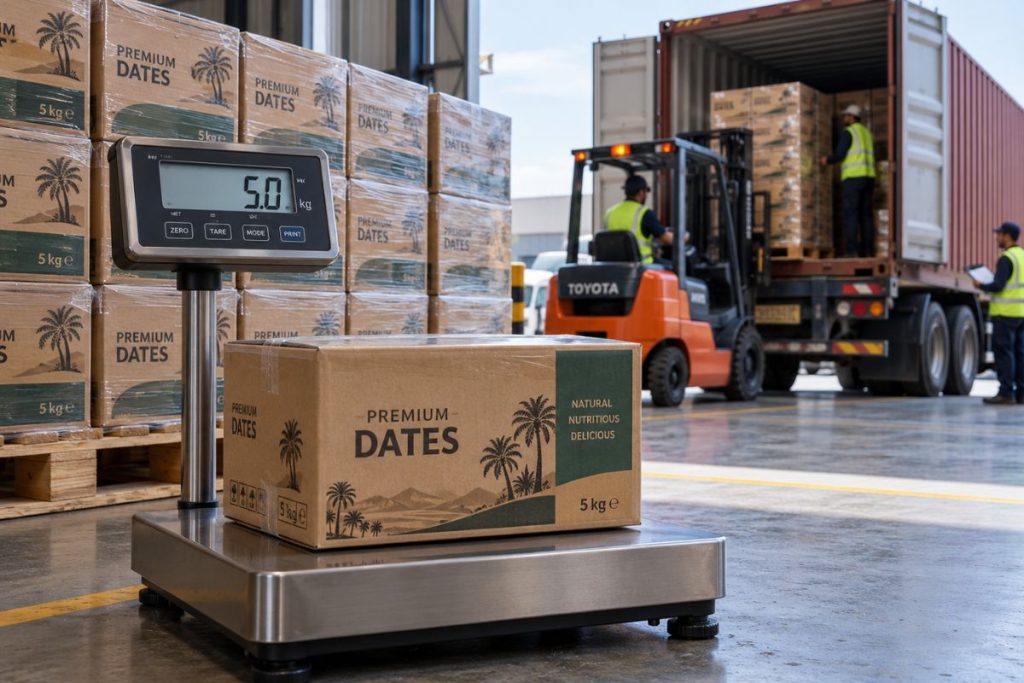
If you are searching for the wholesale dates price per kg GCC, the most important thing to understand is that there is no single market price that applies to every shipment.
A wholesale date priced at USD 2.00 per kg and another quoted at USD 6.00 per kg may both be correctly priced. The difference can come from variety, size, grade, moisture level, packaging, order quantity, season, origin, Incoterm and the final delivery destination.
For B2B buyers, the real question is therefore not simply:
“What is the price per kilogram?”
The better question is:
“What specification, quantity and delivery terms are included in that price?”
Current market observations demonstrate how wide the pricing range can be. UAE trade data for fresh dates in June 2026 showed transaction values ranging from roughly USD 0.69 to USD 3.73 per kg, while individual premium varieties available from regional suppliers can be priced substantially higher. Saudi supplier benchmarks, for example, place commercial Khudri around USD 1.50–3.00/kg while premium Ajwa can reach approximately USD 8–15/kg depending on grade and order conditions.
That difference is exactly why professional procurement teams should never compare date quotations using the headline price alone.
This guide explains what determines wholesale dates pricing across the GCC, how importers should compare quotations, what costs should be included in landed-cost calculations and how to prepare a better RFQ when sourcing dates for wholesale, retail, food service or private-label distribution.
The GCC dates market covers everything from high-volume commercial products to premium retail and gifting varieties.
Wholesale Dates Price per Kg GCC: What Is a Realistic Range?
As a broad procurement reference, commercial bulk dates may begin around the USD 1.50–3.00/kg range under certain supplier and shipment conditions. Mid-market varieties can commonly move into the USD 2.50–7.00/kg range, while premium varieties can reach USD 5.00–15.00/kg or more.
These numbers should be treated as market references rather than fixed price lists.
A useful example comes from published 2026 Saudi wholesale supplier benchmarks:
| Date Variety / Segment | Indicative FOB Price | Approx. AED/kg | Typical Positioning |
| Khudri | USD 1.50–3.00/kg | AED 5.50–11.00 | Volume / commercial |
| Safawi | USD 2.50–5.00/kg | AED 9.20–18.40 | Mid-market / premium |
| Khalas | USD 3.00–6.00/kg | AED 11.00–22.00 | GCC retail |
| Sukkari | USD 3.00–7.00/kg | AED 11.00–25.70 | Popular premium |
| Medjool | USD 5.00–12.00/kg | AED 18.40–44.10 | Premium |
| Ajwa | USD 8.00–15.00/kg | AED 29.40–55.10 | High-premium |
These ranges illustrate the size of the pricing gap between varieties and grades rather than establishing a universal GCC market price.
Fresh market pricing provides another useful comparison. During the UAE’s 2026 date season, consumer-facing fresh dates at Sharjah’s Al Jubail market were reported from AED 15/kg, with substantial variation between varieties. However, retail market pricing should not be confused with bulk export pricing.
For a B2B procurement manager, the correct benchmark is always the price for the same specification under the same commercial terms.
Why Wholesale Dates Prices Vary So Much
Dates are agricultural products rather than standardized industrial commodities.
Two cartons carrying the same variety name can have significantly different commercial value.
Several factors determine the final price.
1. Date Variety
Variety is one of the biggest pricing factors.
High-volume commercial dates normally trade differently from premium varieties such as:
- Piarom
- Maryami / Mariami
- Medjool
- Ajwa
- Sukkari
- Khalas
- Safawi
- Khudri
Each variety has different characteristics relating to appearance, flavor, texture, moisture, availability, consumer recognition and shelf positioning.
A supermarket buying an attractive premium date for a 500 g branded retail pack has completely different specifications from a food manufacturer buying dates for industrial processing.
The price should reflect those differences.
2. Grade Can Matter as Much as Variety
A common mistake among new buyers is asking:
“How much is Piarom per kg?”
or:
“How much are Maryami dates?”
That question is incomplete.
The supplier needs to know the required grade.
Depending on the variety, commercial grading can take into account:
- Fruit size
- Length
- Diameter
- Color consistency
- Skin separation
- Moisture
- Texture
- Surface defects
- Broken fruit
- Insect damage
- Foreign material
- Percentage of damaged dates
- Overall appearance
A premium grade with strong color consistency, larger fruit and tight tolerances will naturally cost more than commercial grade from the same harvest.
This is why B2B buyers should request a written specification sheet before comparing suppliers.
3. Size Changes the Bulk Dates Price per Kg
Larger dates generally command higher prices when size is an important part of the variety’s commercial positioning.
For premium retail packs, consumers often associate large and visually consistent fruit with higher quality.
Suppliers may classify products according to:
- Small
- Medium
- Large
- Extra large
- Jumbo
Others may specify pieces per kilogram or an actual millimeter size.
For procurement purposes, pieces per kilogram can be more useful than simply saying “large.”
Supplier A’s definition of large may not be identical to Supplier B’s.
A professional RFQ should therefore define measurable specifications whenever possible.
4. Moisture and Texture Affect Price and Logistics
Moisture is another important pricing variable.
Dates may be sold as soft, semi-dry or dry varieties. Moisture affects:
- Texture
- Shelf life
- Storage conditions
- Refrigeration requirements
- Shipping method
- Handling
- Product weight
- Consumer preference
FAO guidance recognizes major differences between the Khalal, Rutab and Tamar stages of date maturity and notes that lower-moisture Tamar-stage products are generally better suited to longer-term preservation and year-round marketing.
From a commercial perspective, this means two products with a similar purchase price may produce different logistics costs.
A semi-dry date with stable storage characteristics may provide a better overall landed cost than a more temperature-sensitive variety, depending on the route and distribution model.
5. Order Volume and MOQ Affect Wholesale Pricing
Quantity matters.
A quotation for 500 kg should not automatically be compared with a price quoted for one full container.
Typical purchasing levels might include:
- Sample orders
- Trial orders
- 500–1,000 kg
- Several pallets
- 5 metric tonnes
- 10+ metric tonnes
- Full-container quantities
- Annual supply contracts
Larger confirmed orders can create savings in:
- Production planning
- Packaging procurement
- Pallet utilization
- Inland transport
- Documentation
- Freight allocation
- Warehouse handling
However, buyers should not automatically assume that the largest MOQ creates the best commercial result.
Inventory turnover matters too.
A slightly higher price on a smaller, faster-moving shipment may be better than buying excessive inventory simply to reduce the unit cost.
Packaging Has a Major Effect on Wholesale Dates Price per Kg GCC
Packaging is one of the most frequently overlooked components of a date quotation.
There is a major cost difference between dates supplied in basic export cartons and dates supplied ready for supermarket shelves.
Bulk Packaging
Typical bulk configurations can include larger food-grade cartons or bags intended for:
- Repacking
- Wholesale redistribution
- Food service
- Industrial use
- Local private-label packing
This normally creates the lowest packaging cost per kilogram.
Retail-Ready Packaging
Retail formats may include:
- 250 g packs
- 400 g packs
- 500 g packs
- 1 kg packs
- Trays
- Printed boxes
- Pouches
- Window cartons
The supplier may also have to provide:
- Labels
- Barcodes
- Printed artwork
- Nutritional information
- Batch identification
- Production dates
- Expiry information
- Country-specific compliance information
These additions increase the price per kilogram.
Private Label
Private-label programs add another layer.
The product itself may be identical, but the project can require:
- Custom packaging design
- Printing plates
- Minimum packaging runs
- Barcode implementation
- Label approval
- Product photography
- Master cartons
- Retail displays
A buyer comparing private-label dates against a supplier’s bulk-carton price is therefore not making a like-for-like comparison.
FOB, CIF and DAP Prices Are Not the Same
Another major reason buyers see different date prices is the Incoterm used in the quotation.
A supplier may quote USD 3.20/kg FOB while another supplier offers USD 3.55/kg delivered much closer to the buyer.
The second offer may actually produce the lower landed cost.
Incoterms determine which party handles different parts of the transportation process, costs and risk.
EXW – Ex Works
The buyer takes responsibility for most logistics from the seller’s location.
The product price may appear attractive, but the buyer must arrange collection, export-related transport and the remaining supply chain.
FCA – Free Carrier
The supplier delivers the goods to the agreed carrier or location.
For many containerized and multimodal shipments, FCA can be more appropriate than FOB.
FOB – Free on Board
For qualifying maritime shipments, the supplier delivers the goods on board the vessel at the specified port.
Risk then transfers according to the FOB rule.
CIF – Cost, Insurance and Freight
The seller arranges the main sea freight and required insurance to the specified destination port, although buyers must understand exactly where risk transfers.
DAP – Delivered at Place
The supplier handles transport to the agreed destination, while import clearance and relevant import charges generally remain the buyer’s responsibility.
The International Chamber of Commerce emphasizes that Incoterms define responsibilities, costs and risk allocation between buyer and seller. ICC guidance also notes that FCA is normally more suitable than FOB when containerized goods are handed to a carrier before being loaded on board the vessel.
Therefore, every RFQ should clearly state the required Incoterm and named location.
“CIF” alone is incomplete.
“CIF Jebel Ali, UAE, Incoterms® 2020” is much clearer.
Wholesale Price vs Landed Cost: The Number Buyers Should Really Compare
Professional procurement teams normally care more about landed cost per kilogram than supplier price per kilogram.
A simplified calculation is:
**Product Cost
- Packaging
- Inland Transport
- Export Handling
- Freight
- Insurance
- Documentation
- Customs / Duties Where Applicable
- Import Handling
- Clearance
- Local Delivery
= Landed Cost**
Suppose a buyer receives the following hypothetical quotation:
| Cost Component | USD/kg |
| Dates | $3.20 |
| Packaging | $0.18 |
| Inland/export handling | $0.12 |
| Freight allocation | $0.24 |
| Insurance/documentation | $0.06 |
| Subtotal before destination duties/taxes/clearance | $3.80/kg |
The product has a headline price of USD 3.20/kg, but its commercial cost has already reached USD 3.80/kg before destination-specific taxes, clearance or final local distribution.
That is an 18.75% difference.
For a 20-tonne shipment, small differences become significant.
A difference of only USD 0.10/kg equals USD 2,000 across 20,000 kg.
This is why serious B2B sourcing decisions should be made using a landed-cost model rather than screenshots of supplier price lists.
How Seasonality Affects Dates Wholesale Price in GCC Markets
Dates prices are seasonal.
Harvest timing, inventory levels and major demand periods can all influence availability.
One of the most important demand periods is Ramadan.
Importers, supermarkets, wholesalers, food-service businesses and gifting companies often build inventory before Ramadan rather than during it.
As demand strengthens, buyers may face:
- Reduced availability of preferred grades
- Smaller choice of sizes
- Longer production schedules
- Higher packaging costs
- Freight pressure
- Less negotiating leverage
Some supplier market guidance indicates that certain varieties can experience meaningful increases in the pre-Ramadan period.
For large B2B programs, procurement planning should begin well before the final selling period.
A low price is not useful if the shipment arrives after the buyer’s sales window.
GCC Country Differences Matter
The term “GCC price” can also create confusion because a buyer in Dubai and a buyer in Riyadh may not have the same landed cost.
The six GCC markets are:
- United Arab Emirates
- Saudi Arabia
- Qatar
- Kuwait
- Oman
- Bahrain
Freight routes, clearance procedures, taxes, local warehousing and final-mile transportation can differ.
UAE
Dubai is an important regional food trading, warehousing and re-export hub.
For UAE buyers, pricing may be requested for locations such as:
- Jebel Ali
- Dubai
- Sharjah
- Abu Dhabi
A Dubai warehouse quotation will naturally differ from an FOB origin quotation.
Saudi Arabia
Saudi Arabia has significant domestic date production as well as a large consumer market.
When comparing imported products against local supply, buyers should consider total positioning rather than the fruit cost alone.
Saudi Arabia’s standard VAT rate is currently 15%, including on imports where applicable, although businesses should always confirm the treatment of their specific transaction and recoverability with their tax advisers.
Qatar, Kuwait, Oman and Bahrain
In these markets, freight consolidation, shipment size and trucking costs can have a proportionally larger impact on smaller orders.
For example, the supplier with the cheapest ex-warehouse product may not remain the cheapest once a small shipment is delivered into Qatar or Kuwait.
This makes quotation standardization particularly important for multi-country GCC procurement.
How Grade Tolerance Changes Your Real Cost
Imagine two suppliers.
Supplier A offers dates at:
USD 2.85/kg
Supplier B offers:
USD 3.05/kg
Supplier A initially appears cheaper.
But after inspection, Supplier A’s shipment contains significantly more undersized or cosmetically unsuitable fruit.
If 10% of the product cannot be sold through the buyer’s intended premium retail channel, the effective usable-product cost changes dramatically.
This illustrates an important purchasing principle:
Do not calculate cost only per kilogram purchased. Calculate cost per kilogram that can be sold through the intended channel.
Specifications therefore protect both quality and margin.
What Should Be Included in a Professional Dates Specification?
Before requesting a quote, buyers should prepare a product specification.
At minimum, consider defining:
| Specification | Buyer Requirement |
| Variety | Exact variety |
| Grade | Premium / Grade A / commercial |
| Size | Size range or pieces/kg |
| Moisture | Required range where relevant |
| Color | Agreed standard |
| Skin separation | Maximum tolerance |
| Defects | Maximum acceptable percentage |
| Pitted / unpitted | Specify |
| Packaging | Bulk or retail |
| Pack weight | e.g. 500 g / 1 kg / 5 kg |
| Master carton | Required configuration |
| Private label | Yes / No |
| Quantity | kg / tonnes / containers |
| Destination | City / port / country |
| Incoterm | FCA / FOB / CIF / DAP etc. |
| Required delivery | Target date |
| Certification | Required documents/certificates |
Once these variables are fixed, suppliers can quote much more accurately.
How B2B Buyers Should Request a Wholesale Dates Quote
A weak inquiry looks like this:
“Send your best dates price.”
A professional inquiry looks more like this:
Product: Maryami dates
Grade: Premium commercial
Size: Please specify available size options
Quantity: 10 MT
Packaging: 5 kg export cartons
Destination: Dubai, UAE
Incoterm: Requested FCA and DAP options
Delivery: Required before [date]
Additional requirement: Product specification, packing details, production lead time and available certificates
The second inquiry makes it much easier for the supplier to issue an accurate commercial offer.
It also lets the buyer compare multiple suppliers fairly.
Seven Questions to Ask Before Accepting a Low Price
When a quotation appears unusually cheap, ask why.
1. Is the Grade the Same?
Do not compare premium grade with standard commercial grade.
2. Is the Size the Same?
Check pieces per kilogram or measurable dimensions.
3. Is the Packaging Included?
A bulk-carton price cannot be directly compared with retail-ready packaging.
4. Which Incoterm Is Being Used?
A USD 2.80 EXW quote may eventually cost more than a USD 3.20 FCA or delivered quotation.
5. Is Freight Included?
Ask whether the freight quotation is firm, indicative or subject to change.
6. How Long Is the Quote Valid?
Agricultural commodity and freight prices can move.
A quotation without a validity period creates commercial uncertainty.
7. Is the Product Actually Available?
The cheapest price has no value if the supplier cannot deliver the required grade and quantity within the buyer’s sales window.
When the Cheapest Wholesale Dates Price Is Not the Best Deal
B2B buyers ultimately make money by selling reliably, not simply by purchasing cheaply.
A supplier that saves USD 0.15/kg but causes inconsistent grading, delayed shipments or rejected retail stock can quickly become more expensive than a reliable supplier.
Procurement should therefore consider:
Price + Quality + Consistency + Lead Time + Logistics + Commercial Reliability
For repeat buyers, consistency becomes particularly important.
A supermarket chain cannot easily change the appearance of its product every shipment.
A distributor cannot promise customers one grade and receive another.
And an importer planning a seasonal campaign cannot recover lost sales if goods arrive after the campaign has finished.
The lowest unit price should therefore be treated as one variable rather than the entire purchasing decision.
How to Negotiate a Better Bulk Dates Price per Kg
Good negotiation does not always mean asking the supplier to reduce the price.
Buyers can often improve total economics in several ways.
Consolidate Volume
Instead of purchasing small quantities repeatedly, provide the supplier with a realistic quarterly or annual forecast.
Even if shipments remain separate, predictable demand may improve planning.
Be Flexible on Packaging
If premium printed packaging is not essential, standard packaging with local labeling may reduce cost.
Plan Earlier
Urgent production and freight requirements reduce purchasing flexibility.
Earlier orders give buyers more options.
Compare Multiple Incoterms
Requesting both FCA and delivered pricing can reveal where the supply chain is adding cost.
Separate Essential Specifications from Preferences
Do not pay for a premium characteristic that your end customer does not value.
For example, an industrial buyer may not need the visual consistency required by luxury retail.
Build Repeat Business
Suppliers can plan more effectively around predictable repeat orders than around irregular spot purchases.
A stable buyer-supplier relationship may eventually be more valuable than negotiating every shipment as an isolated transaction.
How Private Label Changes the Commercial Calculation
Private label can significantly increase the value of the final product, but buyers need to understand its effect on price.
A private-label project may introduce:
- Packaging development
- Artwork setup
- Printing minimums
- Packaging inventory
- Barcode requirements
- Regulatory label adaptation
- Additional packing labor
- Quality-control procedures
For retailers and distributors, these additional costs may still make sense because branded retail products normally sell at considerably higher prices than bulk dates.
The right comparison is therefore not:
Bulk price vs private-label price
It is:
Private-label landed cost vs achievable wholesale or retail selling price.
That is a margin calculation rather than a simple procurement calculation.
Wholesale Dates UAE: Why Dubai Matters to GCC Buyers
The UAE plays an important role in regional food trading.
Dubai in particular provides access to:
- International shipping routes
- Warehousing
- Re-export infrastructure
- Regional trucking
- Food traders
- Importers and distributors
- International trade exhibitions
- GCC buyer networks
For buyers purchasing smaller or mixed quantities, sourcing through a UAE trading partner can sometimes simplify procurement compared with managing multiple supply relationships independently.
The benefit is not automatically a lower farm-gate price.
The value may come from:
- Consolidation
- Communication
- Documentation
- Quality coordination
- Shipment management
- Payment structure
- Regional delivery capability
For B2B procurement teams, these operational factors should be included when evaluating supplier value.
A Better Way to Compare Three Supplier Quotes
Assume three suppliers submit the following offers:
| Supplier | Product Price | Terms | Estimated Landed Cost | Grade |
| Supplier A | $2.80/kg | EXW | $3.65/kg | Standard |
| Supplier B | $3.15/kg | FCA | $3.55/kg | Premium |
| Supplier C | $3.40/kg | DAP | $3.40/kg* | Premium |
*Destination duties, taxes or clearance may still apply depending on the exact terms.
If the buyer compares only the first column, Supplier A wins.
If the buyer compares commercial outcome, Supplier C may be the strongest offer.
If Supplier B also offers better payment terms or more flexible packaging, it could become the preferred supplier.
The purpose of procurement analysis is to make these differences visible.
Buyer Checklist for Wholesale Dates Price per Kg GCC
Before confirming an order, check the following:
- Is the exact variety specified?
- Is the grade defined?
- Is size measurable?
- Is moisture specified where necessary?
- Are defect tolerances documented?
- Is the product pitted or unpitted?
- Is net weight clearly stated?
- Is packaging included in the price?
- Are pallet costs included?
- Is private-label work included?
- Is the MOQ clear?
- Is the Incoterm stated?
- Is the named delivery point stated?
- Is freight included?
- Is insurance included where required?
- Are documentation charges included?
- Are destination charges understood?
- Is the quotation validity stated?
- Is production lead time confirmed?
- Is shipment availability confirmed?
- Are payment terms clear?
- Has a product sample been approved?
- Are required certificates available?
- Is there a written specification?
- Has the landed cost per kg been calculated?
This checklist eliminates many of the misunderstandings that occur when buyers focus only on the headline price.
Working With Shahin International Trading
Shahin International Trading approaches dates procurement as a B2B trading relationship rather than simply a price-list transaction.
With 40 years of trading experience and an established international network, Shahin works with importers, wholesalers, distributors and trade buyers requiring professional commercial execution and dependable supply relationships.
For buyers requesting Maryami, Mariami, Piarom or other date products, the best starting point is a clear RFQ containing:
- Required variety
- Grade
- Quantity
- Packaging
- Destination
- Preferred Incoterm
- Delivery schedule
This allows the Shahin trade team to evaluate the requirement and provide a commercially relevant quotation rather than an indicative price that may not match the actual project.
For related sourcing information, buyers can also review Shahin’s bulk dates supplier resources, dates supplier UAE page and Piarom and Maryami dates supplier information.
Frequently Asked Questions
What is the average wholesale dates price per kg in the GCC?
There is no single average that accurately represents the entire market. Depending on variety, grade, season and commercial terms, bulk dates can range from relatively low-cost commercial products around USD 1.50–3.00/kg to premium varieties priced at USD 5–15/kg or more. Buyers should request a quotation for a specific variety, grade, quantity and Incoterm.
Why do wholesale dates prices differ between suppliers?
The main reasons include variety, grade, fruit size, moisture, defects, harvest quality, packaging, order quantity, season, freight, certification requirements and Incoterms.
Two quotations should only be compared after these specifications have been standardized.
Are bulk dates cheaper than retail-packed dates?
Normally, yes.
Bulk packaging requires less material and less individual packing work. Retail-ready packs can require trays, printed cartons, labels, barcodes and additional packing processes, increasing the cost per kilogram.
Does a larger order always mean a lower price?
Larger orders generally provide better opportunities for cost efficiency, but not always.
Variety availability, harvest conditions, packaging requirements and freight capacity can still influence pricing.
Buyers should compare total inventory economics as well as price per kilogram.
Is FOB price the same as landed price?
No.
FOB covers the seller’s responsibilities according to the agreed FOB port and Incoterms® rule. Main freight, destination expenses, import processes and onward transportation may still be the buyer’s responsibility.
Landed cost is the more useful measurement when comparing suppliers.
Should buyers request FOB or CIF pricing?
It depends on the buyer’s logistics capability.
Experienced importers with established freight contracts may prefer greater control over transportation. Other buyers may prefer the supplier to arrange more of the shipment.
For containerized cargo, buyers should also consider whether FCA is technically more appropriate than FOB.
When should GCC buyers purchase dates for Ramadan?
Major orders should generally be planned well ahead of Ramadan.
Waiting until demand is already high can reduce access to preferred grades, sizes, packaging capacity and freight options.
Large buyers should coordinate procurement, packaging and logistics as part of a seasonal supply plan.
How much does private-label packaging add to the price?
There is no standard amount.
The additional cost depends on pack size, material, printing volume, carton design, labels, barcodes, master cartons and packaging MOQ.
Private-label buyers should request separate product and packaging cost information whenever possible.
What information should I provide to receive an accurate dates quotation?
Provide the variety, grade, quantity, size requirement, packaging, destination, Incoterm and required delivery date.
If you have a technical specification or sample requirement, include it in the RFQ.
How long is a wholesale dates quotation normally valid?
Validity depends on market conditions, inventory and freight.
B2B buyers should never assume an indicative price remains open indefinitely. Always request the quotation validity period in writing.
Final Takeaway: Wholesale Dates Price Per kg GCC
Searching for the wholesale dates price per kg GCC is a useful starting point, but professional B2B purchasing requires a deeper comparison.
The number that matters is not simply the supplier’s product price.
It is the cost of receiving the correct product, in the correct condition, at the correct location, at the correct time.
A strong dates RFQ should therefore define:
Variety + Grade + Size + Quantity + Packaging + Incoterm + Destination + Delivery Date
Only after these variables are standardized can buyers make a fair price comparison.
For procurement managers, importers, wholesalers and distributors, the best supplier is rarely determined by one number on a quotation. Quality consistency, commercial terms, logistics execution and dependable delivery all affect the final margin.
Planning your next dates order?
Send Shahin International Trading your required variety, specification, quantity, packaging format and destination to receive a B2B quotation based on your actual procurement requirement.