
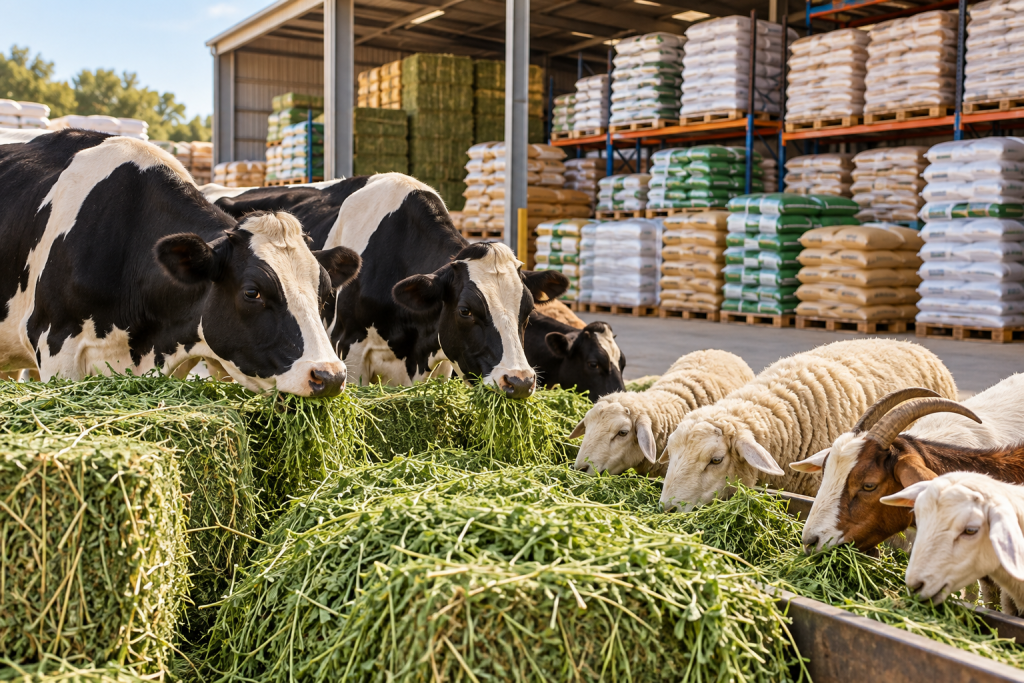
Finding dependable bulk animal feed suppliers Dubai importers can work with is essential for businesses that depend on consistent feed quality, competitive procurement costs, and predictable international deliveries. Whether you manage livestock operations, distribute agricultural commodities, manufacture animal feed, or purchase forage for commercial farms, choosing the right trading partner directly affects your supply chain.
Dubai is an important commercial gateway connecting international commodity producers with buyers across the United Arab Emirates, GCC countries, and other global markets. Its trading infrastructure makes it a practical location for businesses seeking agricultural products and international sourcing relationships.
However, identifying a supplier is only the beginning. Professional procurement requires careful evaluation of commodity specifications, nutritional characteristics, quality documentation, packaging, shipment conditions, and commercial terms.
For buyers sourcing animal feed in commercial quantities, Shahin International Trading offers a UAE-based B2B trading approach built around product requirements, supply discussions, and long-term business relationships.
Through its wholesale animal feeds portfolio, Shahin Trading serves buyers interested in commodities such as feed corn, canary seed, and alfalfa hay.
This guide explains how importers can evaluate bulk animal feed suppliers, select suitable commodities, compare quotations, manage procurement risks, and establish reliable sourcing arrangements.
Why Dubai Is a Strategic Market for Bulk Animal Feed Sourcing
Dubai has developed into an international trading center connecting agricultural commodity markets with regional distributors and commercial buyers.
For animal feed importers, the value of operating through Dubai extends beyond geographical location. Procurement teams also benefit from access to established logistics services, freight forwarding networks, commercial trading companies, and international shipping connections.
Access to International Commodity Markets
Animal feed supply chains frequently involve multiple producing countries.
Grains, seeds, and forage products may originate in different agricultural regions depending on seasonal availability, production conditions, product specifications, and trade restrictions.
An importer might source feed corn from one region while purchasing alfalfa hay or specialized seeds from another.
Working with a UAE-based trading company can simplify commercial communication when evaluating different supply options.
Instead of focusing exclusively on identifying individual producers, buyers can discuss their requirements with a trading partner familiar with international commodity transactions.
However, supplier location alone does not guarantee favorable prices or product availability. Buyers should compare actual shipment origins, quality specifications, and delivered costs.
Logistics Infrastructure for Regional Distribution
Dubai provides access to international ports, warehousing services, road transport, and freight networks.
These services can support different commercial arrangements, including direct importation, local distribution, onward shipment, and regional re-export.
For companies supplying farms, wholesalers, or feed manufacturers, efficient logistics planning is particularly important.
Late deliveries can interrupt feed manufacturing schedules or create inventory shortages for agricultural customers.
A dependable sourcing strategy therefore considers the complete supply chain, not only the purchase price of the commodity.
Commercial Advantages for GCC Importers
Buyers serving the UAE, Saudi Arabia, Oman, Bahrain, Kuwait, and Qatar may find Dubai useful as a commercial coordination point.
Nevertheless, importing through Dubai is not always the most economical option.
Depending on the commodity and final destination, direct shipments from the origin country may reduce handling costs and transit time.
Experienced procurement teams compare both approaches before confirming a transaction.
The objective is to select the most practical combination of cost, documentation, delivery schedule, and product quality.
What Products Do Bulk Animal Feed Suppliers Dubai Buyers Commonly Source?
Animal feed commodities are not interchangeable.
Different products serve different nutritional and operational purposes, and their suitability depends on the animal species, intended feeding program, and required formulation.
Commercial buyers should begin by identifying the exact commodity and specifications before contacting suppliers.
The following categories illustrate several important products and sourcing considerations.
Feed Corn for Livestock and Poultry Applications
Feed corn is an important energy-providing ingredient in many commercial animal feeding programs.
It is commonly used in formulations for poultry, cattle, and other livestock, subject to the nutritional requirements of the relevant species.
For feed manufacturers, corn quality can influence consistency across production batches.
Procurement managers should pay particular attention to moisture, foreign matter, grain condition, and relevant contaminant limits.
Important commercial specifications may include:
- Moisture percentage
- Broken grain percentage
- Foreign matter tolerance
- Damaged or discolored kernels
- Relevant mycotoxin test results
- Country of origin
- Packaging and shipment method
- Minimum order quantity
The appropriate limits should be agreed according to the intended application and destination-market regulations.
For businesses looking for bulk feed corn and other animal feed commodities, Shahin Trading provides a channel for discussing product requirements and commercial quotations.
Alfalfa Hay for Commercial Livestock Operations
Alfalfa hay is a forage product commonly used in feeding programs for dairy cattle, horses, and other herbivorous livestock.
Its commercial value depends on several factors, including maturity at harvest, leaf retention, fiber composition, moisture, and overall condition.
High-quality alfalfa is not defined by appearance alone.
Buyers should consider laboratory analysis when evaluating nutritional characteristics, especially for large or recurring purchases.
Important specifications may include:
- Crude protein content
- Neutral detergent fiber (NDF)
- Acid detergent fiber (ADF)
- Moisture content
- Bale dimensions and weight
- Leaf retention and visible condition
- Presence of mold or foreign material
- Storage and transport requirements
The nutritional profile must match the intended animal feeding program.
For example, a dairy operation may have different forage requirements from an equine distributor or general livestock wholesaler.
Shahin Trading lists alfalfa hay within its animal feeds range, allowing commercial buyers to discuss their required grade, quantity, and packing preferences.
Canary Seed for Bird-Feed Manufacturers and Distributors
Canary seed is a specialized commodity commonly associated with bird-feed applications.
For businesses supplying bird-food manufacturers, pet product distributors, or agricultural wholesalers, consistency and cleanliness are important purchasing considerations.
Unlike broad-use feed grains, specialized seeds may involve different grading standards, processing requirements, and end-market expectations.
Procurement teams should evaluate:
- Seed cleanliness
- Moisture level
- Foreign seed contamination
- Uniformity and appearance
- Packaging format
- Product origin
- Storage conditions
- Applicable quality certificates
For distributors, packaging requirements may differ significantly from those of industrial buyers.
One customer may require bulk bags for repacking, while another may purchase smaller wholesale units.
Buyers can explore canary seed sourcing through Shahin Trading and request specifications based on their intended application.
Other Feed Commodities and Sourcing Requirements
Commercial feed procurement can also involve barley, soybean meal, wheat bran, and other agricultural ingredients.
These commodities are widely relevant to the broader animal feed industry, but availability should never be assumed.
The fact that a trading company operates in agricultural commodities does not automatically mean every feed ingredient is currently offered.
Buyers requiring products outside a supplier’s published portfolio should submit a separate sourcing inquiry.
For a broader view of available categories, explore Shahin Trading’s B2B food and agricultural commodities portfolio.
How to Evaluate Reliable Bulk Animal Feed Suppliers in Dubai
Choosing a supplier involves more than comparing advertised prices.
Professional buyers should assess product suitability, commercial transparency, operational reliability, and the ability to support repeat orders.
A structured evaluation process helps reduce procurement risk.
1. Verify the Supplier’s Business and Trading Credentials
Before entering a commercial relationship, buyers should establish the supplier’s legal identity and relevant business activities.
Depending on the transaction, appropriate checks may include the company’s trade license, registered business details, authorized representatives, and relevant sector permissions.
Buyers should also confirm whether the supplier operates as a manufacturer, distributor, importer, exporter, or trading intermediary.
These business models are not necessarily better or worse than one another.
What matters is understanding the company’s role in the transaction and who is responsible for product quality, documentation, shipment, and claims.
An established commercial history may support credibility, but experience should be considered alongside transaction-specific evidence.
2. Request Detailed Commodity Specifications
One of the most common procurement mistakes is asking for a quotation without defining the product adequately.
A request for “100 tons of animal feed” is insufficient for a meaningful comparison.
Even a request for “feed corn” may be too broad.
A more useful inquiry identifies the commodity, expected grade, intended use, analytical requirements, packaging format, and delivery destination.
This enables suppliers to provide quotations based on comparable conditions.
It also reduces the possibility of receiving a product that satisfies a general description but fails the buyer’s operational requirements.
3. Evaluate Quality Control and Testing
Animal feed quality influences animal health, feed manufacturing consistency, and potentially the safety of food products derived from livestock.
Accordingly, feed safety should be treated as a core procurement requirement.
The FAO and WHO Codex Alimentarius guidance on good animal feeding provides an internationally recognized reference for responsible feed practices.
The guidance addresses safety considerations throughout feed production and handling.
Commercial buyers should request relevant quality documentation and establish clear acceptance criteria before shipment.
Testing requirements depend on the commodity.
Grains may require screening for specific mycotoxins, while forage products may need nutritional analysis and moisture verification.
Independent inspection can also be considered where the transaction value or risk profile justifies it.
4. Assess Commercial Communication
Reliable supplier relationships depend on accurate and timely information.
Procurement managers should evaluate how clearly a supplier communicates about availability, pricing, product grades, shipping schedules, and documentation requirements.
A supplier who answers questions precisely can help buyers identify potential problems before a purchase order is issued.
This does not mean every inquiry requires an immediate offer.
For commodities affected by market movements or seasonal availability, a responsible supplier may need to reconfirm pricing and stock before issuing a final quotation.
5. Review Repeat-Order Capability
A single successful delivery is useful, but long-term procurement requires consistency.
Importers should ask how recurring orders are managed, whether lead times change seasonally, and what happens when the requested grade becomes unavailable.
Buyers should also establish procedures for specification changes, product substitutions, delayed shipments, and quality claims.
These discussions are especially important for feed factories and distributors serving customers on fixed delivery schedules.
Bulk Animal Feed Quality Standards Every Importer Should Understand
Quality assurance should begin before the product is loaded.
For procurement managers, clear specifications create a shared understanding between the supplier, buyer, laboratory, and logistics provider.
Moisture and Storage Stability
Moisture affects the storage behavior of many agricultural commodities.
Excessive moisture can encourage deterioration and increase the risk of mold development under unfavorable conditions.
However, acceptable moisture limits vary by product, storage method, regulatory requirement, and intended use.
Buyers should avoid applying a single moisture target to every feed commodity.
Instead, establish the appropriate specification and confirm how the product will be protected during transit.
For sea shipments, packaging, ventilation, condensation management, and container condition may require particular attention.
Nutritional Composition
Feed procurement should also account for the nutritional role of each ingredient.
Relevant measurements may include crude protein, fiber fractions, energy characteristics, and mineral composition.
The importance of each parameter depends on whether the commodity is used as forage, an energy ingredient, or part of a manufactured feed formulation.
For example, alfalfa hay evaluation may emphasize protein and fiber characteristics, while feed corn purchasing may prioritize grain condition, energy contribution, and safety parameters.
Procurement and nutrition teams should work together when defining specifications.
Contaminants and Product Safety
Agricultural feed materials can be affected by biological, chemical, or physical hazards.
Potential concerns include mycotoxins, pesticide residues, unwanted foreign matter, and inappropriate storage contamination.
The relevant testing program should be determined by the commodity, origin, risk assessment, and destination-market requirements.
The FAO–IFIF Good Practices for the Feed Sector manual provides additional guidance on responsible practices throughout feed operations.
Buyers should incorporate risk-based verification rather than relying solely on a visual inspection.
Traceability and Batch Identification
Traceability becomes especially important when a quality concern arises after delivery.
Purchase orders and supporting documents should make it possible to identify the relevant shipment and product lot.
Where applicable, buyers should request batch references, production or packing details, inspection records, and associated test reports.
Clear traceability can simplify communication if a shipment requires investigation or corrective action.
Comparing Wholesale Animal Feed Suppliers: A Practical B2B Framework
Price is important, but the lowest quotation does not always represent the lowest procurement cost.
A supplier comparison should account for operational, quality, and commercial risks.
The table below provides an illustrative evaluation framework.
| Evaluation factor | What importers should check | Why it matters |
|---|---|---|
| Product specifications | Grade, moisture, nutrients, contaminants | Determines product suitability |
| Supplier credentials | Registration, trading role, authorizations | Supports counterparty due diligence |
| Quality documentation | Analysis reports, inspection records | Reduces uncertainty |
| Pricing | Currency, quotation validity, price basis | Enables fair comparison |
| MOQ | Minimum commercial quantity | Affects inventory planning |
| Packaging | Bale, bag, bulk, pallet configuration | Influences handling costs |
| Lead time | Preparation and shipment schedule | Supports continuity of supply |
| Incoterms | Agreed delivery responsibilities | Clarifies cost and risk allocation |
| Payment conditions | Deposit, balance, banking terms | Influences financial exposure |
| After-sales process | Claims and dispute procedures | Supports risk management |
Build a Weighted Supplier Scorecard
Procurement managers can assign weights according to business priorities.
For example, an illustrative scorecard might allocate:
- Product quality and suitability: 30%
- Landed cost: 25%
- Delivery reliability: 20%
- Documentation and compliance: 15%
- Communication and service: 10%
These percentages are only an example, not an industry standard.
A feed manufacturer with strict production deadlines may assign greater importance to delivery reliability.
An importer serving a highly regulated destination may increase the weight assigned to documentation and compliance.
The best supplier is the one that consistently meets the buyer’s actual requirements.
Compare Equivalent Quotations
Always confirm that competing quotations cover the same grade, quantity, packaging, delivery basis, and destination.
A lower FOB quotation should not be compared directly with a higher CIF quotation without accounting for freight and insurance.
Likewise, different product grades may have materially different commercial values.
An accurate comparison requires consistent assumptions.
Animal Feed Import Regulations and Documentation in the UAE
International animal feed sourcing requires careful attention to regulatory compliance.
Importers should not assume that every feed commodity follows the same approval procedure.
Requirements can differ according to product composition, processing status, intended use, and classification.
UAE Import Permits and Product Approval
The UAE Ministry of Climate Change and Environment, commonly known as MOCCAE, administers relevant approval and import procedures for various animal feed and related products.
The ministry’s animal feed and fodder import guidance provides information about the applicable digital services.
Certain products may require prior registration, product approval, import permission, and release procedures.
These requirements should be verified before shipment arrangements are finalized.
Green and dried fodder may be treated differently from some manufactured feed categories. Importers should therefore confirm the correct regulatory classification for the specific commodity.
Commercial Documentation
Depending on the product, destination, and agreed trade terms, international feed shipments may require:
- Commercial invoice
- Packing list
- Bill of lading or other transport document
- Certificate of origin
- Relevant quality or laboratory certificates
- Applicable phytosanitary or other regulatory documents
- Import permits or approvals where required
- Insurance documentation when applicable
This is a planning checklist rather than a universal mandatory-document list.
The importer or customs representative should confirm the actual requirements for each shipment.
Why Documentation Planning Matters
Incomplete or inconsistent documents can result in customs delays, additional storage charges, and disruption to planned deliveries.
The buyer and supplier should agree on document requirements before cargo dispatch.
Names, quantities, product descriptions, consignee information, and shipment references should be consistent across commercial and transport documents.
A simple pre-shipment document review can prevent costly problems.
Understanding Animal Feed Prices in Dubai and the GCC
Wholesale animal feed prices vary according to commodity type, origin, grade, international supply conditions, and logistics requirements.
Importers seeking competitive sourcing should focus on the factors influencing the final delivered cost.
Commodity Origin and Seasonal Availability
Agricultural production is affected by harvest timing, weather, transportation conditions, and international demand.
These factors can influence availability and pricing.
Feed corn prices may respond to grain market conditions, while forage prices may be affected by harvest quality, baling costs, storage requirements, and freight.
Buyers should request quotations with clearly defined validity periods because commodity prices can change.
Packaging and Shipment Configuration
Packaging affects both unit cost and operational efficiency.
Bulk grain shipments, large industrial bags, and conventional sacks involve different handling requirements.
Alfalfa hay may be transported in compressed bales, subject to product specifications and shipment arrangements.
Packaging selection influences freight utilization, warehouse handling, unloading procedures, and product protection.
The cheapest packaging option is not necessarily the most efficient option for the buyer.
Incoterms and Freight Responsibilities
International procurement contracts commonly reference Incoterms to define delivery obligations and the allocation of certain costs and risks.
Common terms include FOB, CFR, and CIF for appropriate sea-freight transactions.
Buyers should specify the named port and the agreed Incoterms version.
For example, a quotation might use CIF Jebel Ali Port, Incoterms 2020.
The chosen term affects how freight arrangements and certain responsibilities are allocated, but it does not replace a complete sales contract.
Calculate Total Landed Cost
An effective purchasing decision considers more than the supplier’s invoice.
Depending on the transaction, landed cost may include:
Product price + freight + insurance + duties and taxes + clearance charges + port handling + inland transport + other applicable costs.
The calculation should also account for expected losses, inspection expenses, and financing costs where relevant.
Comparing landed cost per usable metric ton provides a more meaningful purchasing benchmark than comparing headline quotations alone.
Minimum Order Quantities and Packaging for Bulk Animal Feed
MOQ and packaging requirements are essential elements of an animal feed RFQ.
However, there is no single universal MOQ that applies to all suppliers or products.
Commercial quantities depend on commodity type, available inventory, source location, packing format, and freight arrangement.
Bulk Feed Corn Orders
Feed corn may be purchased in bags, larger industrial packing units, or bulk shipment configurations.
The suitable method depends on the buyer’s unloading equipment, storage infrastructure, and destination.
Feed manufacturers may prioritize efficient bulk handling, while distributors may need bagged quantities for resale.
Alfalfa Hay Bale Shipments
Alfalfa hay buyers should specify bale weight, dimensions, compression format, and acceptable tolerances.
Container loading plans should account for both payload limits and space utilization.
Because hay has different physical characteristics from dense grains, its transport economics require separate consideration.
Packaging for Distributors and Wholesalers
Importers serving smaller commercial customers may require packaging that supports straightforward handling and redistribution.
Relevant requirements include bag integrity, label information, pallet stability, product identification, and storage instructions.
Where repacking or private-label supply is requested, buyers should confirm feasibility and commercial conditions before placing an order.
Shahin Trading’s animal feeds category provides an opportunity to discuss commercial quantities and available packing arrangements.
Exact MOQ, packaging, and delivery conditions should be confirmed through a quotation.
How Importers Can Reduce Risk in Bulk Animal Feed Procurement
Importing agricultural commodities involves multiple risks that cannot be eliminated through supplier selection alone.
Effective procurement combines due diligence, product specifications, commercial safeguards, and realistic logistics planning.
Request Representative Samples
Samples can help buyers assess certain product characteristics before committing to larger orders.
However, a sample is only useful when it is representative of the material that will actually be supplied.
For recurring transactions, buyers should agree on sampling procedures and the relationship between approved samples and shipment acceptance.
Where necessary, independent sampling and laboratory analysis should be considered.
Establish Written Acceptance Criteria
Contracts should define product requirements clearly.
Relevant provisions may cover:
- Agreed specification limits
- Inspection and sampling procedures
- Quantity tolerances
- Documentation requirements
- Delivery deadlines
- Procedures for handling nonconforming goods
- Claims notification periods
- Payment and dispute arrangements
Commercial buyers should seek appropriate legal and technical review for high-value or complex contracts.
Avoid Overdependence on One Supply Origin
An importer may have a reliable commercial supplier while still facing disruptions in the underlying producing country.
Seasonal shortages, shipping interruptions, and regulatory changes can affect the movement of commodities.
Procurement teams should assess origin exposure and identify contingency options where practical.
Diversification can improve resilience, although multiple origins may involve different specifications and costs.
Plan Inventory Around Actual Demand
Ordering too much feed can increase storage expenses and product deterioration risks.
Ordering too little may create operational shortages.
The appropriate inventory strategy depends on product shelf life, storage capacity, lead times, and consumption patterns.
Importers should use realistic demand forecasts and adjust purchasing schedules when market conditions change.
Step-by-Step Guide: How to Source Bulk Animal Feed from Dubai
A structured purchasing process makes supplier evaluation faster and helps reduce unnecessary commercial misunderstandings.
Step 1: Define Your Commodity Requirements
Begin with the exact product.
For example, specify feed corn, alfalfa hay, or canary seed rather than using the broad term animal feed.
Record the intended use, quality requirements, destination market, and any mandatory standards.
Step 2: Determine Purchase Volume
Estimate the required quantity in metric tons or another appropriate unit.
Clarify whether the inquiry is for a one-time shipment, trial order, or recurring monthly procurement.
Suppliers can evaluate commercial feasibility more effectively when the expected volume is clear.
Step 3: Identify Packaging and Delivery Requirements
Specify whether you require bulk handling, commercial bags, compressed bales, or another packing configuration.
Provide the destination port or delivery point.
If you have a preferred Incoterm, include it in your inquiry.
Step 4: Shortlist Suitable Suppliers
Evaluate prospective suppliers against objective criteria.
Review their published product range, commercial credentials, ability to discuss specifications, and willingness to provide appropriate documentation.
For buyers searching for bulk animal feed suppliers Dubai, Shahin Trading can be included in the evaluation for the animal feed commodities listed in its portfolio.
Step 5: Request Comparable Quotations
Ask each supplier to quote against the same requirements.
A useful quotation should identify the product, grade, quantity, unit price, currency, price basis, packing, estimated shipment timing, and payment conditions.
Clarify whether laboratory testing, inspection, and documentation costs are included.
Step 6: Verify Product and Commercial Conditions
Before confirming an order, review available product evidence and agree on the inspection process.
Check the supplier’s legal information and confirm that payment details are consistent with the contracted counterparty.
For larger or unfamiliar transactions, consider appropriate third-party verification.
Step 7: Confirm the Purchase Order
The purchase order or contract should reflect the agreed technical and commercial requirements.
Do not rely exclusively on informal messages to establish material terms.
Clearly document the specification, shipment quantity, delivery conditions, payment obligations, and claims procedures.
Step 8: Monitor Shipment and Delivery
Agree on shipment updates and document submission procedures.
Track relevant milestones such as cargo readiness, inspection, dispatch, estimated arrival, and customs release.
After delivery, record product performance and any issues for future supplier evaluations.
Why Work With Shahin International Trading for Animal Feed Sourcing?
Importers and commercial buyers often prefer trading relationships that support clear communication and repeatable procurement processes.
Shahin International Trading is a UAE-based B2B commodity trading company with four decades of trading experience.
Its broader business model focuses on serving importers, wholesalers, distributors, and commercial buyers across international markets.
A B2B Trading Approach
Shahin Trading’s sourcing process begins with understanding the buyer’s requirements.
These include product type, grade, quantity, packaging preferences, destination, and required commercial terms.
For animal feed inquiries, this approach helps establish a clear basis for discussing suitable supply arrangements.
Rather than treating all buyers as having identical needs, commercial discussions can be structured around the intended application.
Animal Feed Commodities for Different Buyers
Shahin Trading’s published animal feed range includes:
Feed Corn: For buyers sourcing grain ingredients for livestock feeding and commercial feed applications.
Canary Seed: For distributors and buyers serving bird-feed and related wholesale markets.
Alfalfa Hay: For commercial forage requirements, including livestock and equine-related supply channels.
Buyers can review these categories on the Shahin Trading Animal Feeds page.
Product availability, grades, current prices, and shipment conditions are subject to quotation and confirmation.
Broader B2B Commodity Sourcing
Some procurement departments manage several agricultural and food commodity categories simultaneously.
A trading partner with a broader product portfolio may provide a useful point of contact for multiple inquiries.
Alongside animal feeds, Shahin Trading presents categories including cereals, pulses, seeds, dried fruits, and dates.
The company’s dates category is particularly relevant to food wholesalers, supermarket distributors, importers, and private-label buyers.
Businesses purchasing agricultural commodities may therefore also discuss separate requirements for wholesale dates supply, where relevant to their product portfolio.
The availability and commercial conditions of each category should be evaluated independently.
Experience in International Trading
Established trading experience can be valuable when coordinating business relationships across countries and markets.
Shahin Trading emphasizes long-term commercial relationships, quality-oriented product discussions, and professional trade communication.
Its B2B approach is relevant to buyers who need more than a basic product listing.
Importers can learn more about the company’s history and commercial positioning on the About Shahin Trading page.
Animal Feed Procurement Checklist for Importers
Before requesting a formal quotation, procurement managers can use this checklist to organize their requirements.
| Procurement item | Information to prepare |
|---|---|
| Commodity | Corn, alfalfa hay, canary seed, or other requested material |
| Intended use | Livestock, poultry, equine, bird feed, or feed manufacturing |
| Quality | Grade, analytical requirements, allowable tolerances |
| Quantity | Metric tons, bags, bales, or recurring volume |
| Packaging | Bulk, bags, bales, pallets, or agreed format |
| Destination | Country, port, or final delivery address |
| Delivery | Target shipment period and delivery terms |
| Documents | Regulatory, quality, and shipping records |
| Inspection | Sampling and testing requirements |
| Commercial terms | Payment method, currency, quotation validity |
| Repeat purchases | Monthly or seasonal demand forecast |
The more complete the inquiry, the easier it becomes to compare suppliers on an equivalent basis.
A well-prepared RFQ also helps avoid delays caused by repeated clarification requests.
For multi-product procurement, create a separate specification sheet for each commodity.
Frequently Asked Questions About Bulk Animal Feed Suppliers Dubai
Who are bulk animal feed suppliers in Dubai?
Bulk animal feed suppliers in Dubai may include trading companies, importers, distributors, and businesses supplying grains, forage, seeds, or manufactured feeds.
Their business models and available products differ.
Shahin International Trading is a UAE-based B2B commodity trading company listing feed corn, canary seed, and alfalfa hay within its animal feed portfolio.
What animal feed commodities can importers source through Shahin Trading?
Shahin Trading currently presents corn, canary seed, and alfalfa hay on its website.
These products serve different commercial applications.
Buyers should submit their intended use, specifications, volume, and destination to confirm available sourcing options.
What is the minimum order quantity for wholesale animal feed?
Minimum order quantities depend on the product, source, packaging, and shipping arrangements.
There is no universal MOQ applicable to every animal feed commodity.
Importers should request a product-specific quotation rather than assuming that an advertised bulk price applies to any order size.
How can importers verify animal feed quality?
Importers should define specifications, request relevant analytical information, establish inspection procedures, and verify that the product meets applicable safety requirements.
Independent sampling and laboratory testing may be appropriate for higher-risk or higher-value shipments.
Quality assessment should reflect the specific commodity and its intended use.
Is Dubai suitable for sourcing animal feed for GCC markets?
Dubai can serve as a commercial coordination and logistics center for regional buyers.
However, the most economical supply route depends on the shipment origin, destination, freight costs, regulatory requirements, and delivery schedule.
Importers should compare direct shipment and Dubai-based arrangements when both are feasible.
Can animal feed suppliers provide private-label packaging?
Some suppliers offer repacking or private-label arrangements, but availability depends on the commodity, order volume, packaging facilities, and commercial agreement.
Buyers should confirm the required packaging format, labeling responsibilities, and applicable approvals before proceeding.
What documents are needed to import animal feed into the UAE?
Depending on the product, documentation may include invoices, packing lists, transport documents, certificates of origin, product approvals, import permits, and relevant quality or regulatory certificates.
Requirements differ by product classification.
Importers should confirm current obligations with the relevant UAE authorities before shipment.
How do I compare quotations from animal feed suppliers?
Compare quotations using identical quality specifications, quantities, packaging, Incoterms, destinations, and shipment timing.
Calculate total landed cost rather than focusing only on product price.
Also consider documentation, delivery reliability, and agreed quality assurance measures.
Can Shahin Trading support recurring commercial inquiries?
Shahin Trading’s B2B commercial model is designed around discussions with importers, wholesalers, distributors, and other professional buyers.
Companies with recurring demand can provide their expected volumes and purchasing schedules for evaluation.
Actual supply capacity and terms must be confirmed for each commodity and sourcing arrangement.
How can I request a bulk animal feed quotation in Dubai?
Prepare your required commodity, grade, quantity, packaging format, destination, and delivery timeline.
Then submit an inquiry using the Shahin Trading contact page.
Providing a detailed RFQ helps the trading team assess the request and discuss appropriate commercial options.
Conclusion: Choosing the Right Bulk Animal Feed Trading Partner
Finding reliable bulk animal feed suppliers Dubai businesses can depend on requires a structured approach to procurement.
Importers should evaluate more than price alone.
Product specifications, supplier credentials, safety requirements, documentation, logistics, and commercial transparency all influence the success of an international feed transaction.
Feed corn, canary seed, and alfalfa hay serve different markets and applications. Each requires its own quality standards, packaging considerations, and purchasing criteria.
By establishing clear requirements before requesting quotations, buyers can compare sourcing options more effectively, reduce avoidable risks, and develop stronger long-term supplier relationships.
For commercial buyers searching for a UAE-based trading partner, Shahin International Trading provides a B2B point of contact for discussing its listed animal feed commodities and broader agricultural sourcing requirements.
Its experience-led approach is relevant to businesses that value clear specifications, professional communication, and commercially practical procurement discussions.
Request a Bulk Animal Feed Quotation from Shahin Trading
Looking for feed corn, alfalfa hay, or canary seed in commercial quantities?
Shahin International Trading welcomes inquiries from animal feed importers, wholesalers, distributors, agricultural companies, and procurement managers.
Share your product specifications, expected volume, packaging requirements, and delivery destination so the team can review your sourcing needs.
Contact Shahin Trading and Request a B2B Quote
Or explore the Animal Feeds Wholesale Supply Portfolio to learn more about the listed commodities.