
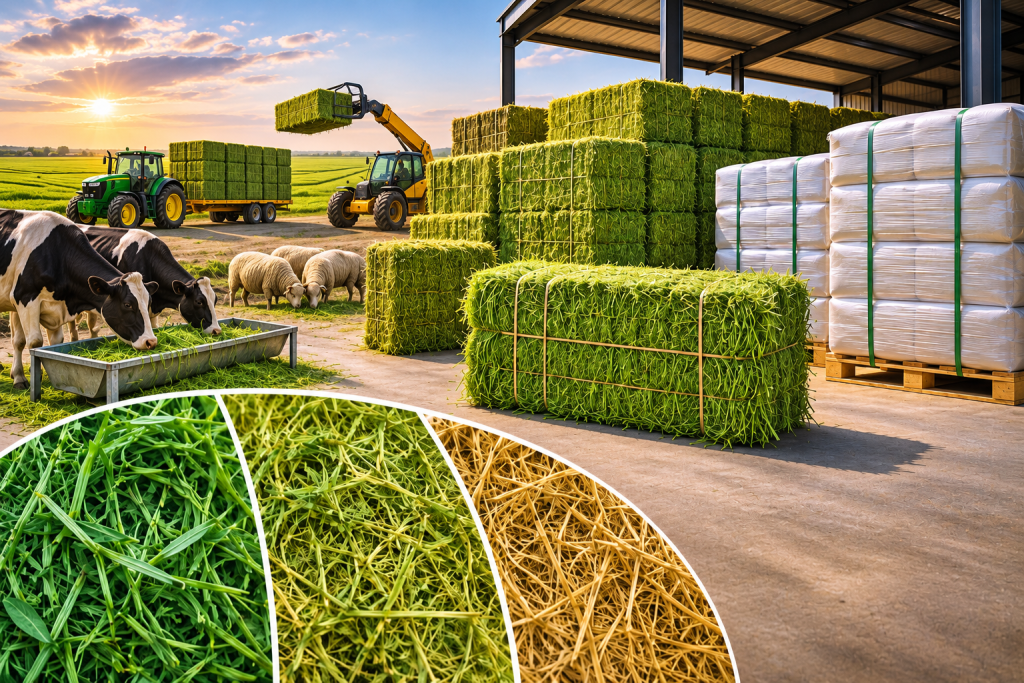
Alfalfa hay wholesale is an important procurement category for livestock feed distributors, dairy farms, agricultural importers, and commercial feed businesses seeking reliable forage supplies. As global agricultural trade continues to connect producers and buyers, purchasing alfalfa hay in bulk requires more than finding an attractive price.
Professional buyers must evaluate nutritional specifications, quality grades, moisture levels, bale sizes, packaging formats, minimum order quantities (MOQ), and international shipping requirements before confirming a commercial order.
Alfalfa hay is widely valued for its protein content, digestible nutrients, and suitability for different livestock feeding programs. However, not all alfalfa hay offers the same nutritional value or commercial performance.
Differences in harvesting conditions, plant maturity, processing methods, storage conditions, and transportation can significantly affect quality.
For importers purchasing container-load quantities, these differences directly influence livestock nutrition, feed efficiency, landed costs, and customer satisfaction.
Working with a trading partner that understands international commodity procurement can simplify the sourcing process.
Shahin International Trading is a UAE-based B2B commodity trading company supporting wholesale buyers, distributors, and international importers.
Through its animal feeds wholesale portfolio, Shahin Trading offers sourcing discussions for alfalfa hay alongside other agricultural feed commodities.
This guide explains everything procurement managers should consider when purchasing wholesale alfalfa hay, including grades, nutritional standards, packaging, MOQ, supplier evaluation, and international shipping.
What Is Alfalfa Hay and Why Is It Important for Wholesale Buyers?
Alfalfa hay is a dried forage produced from the alfalfa plant (Medicago sativa), a perennial legume cultivated for livestock feeding.
Unlike cereal grains, which primarily supply concentrated energy, alfalfa hay provides a combination of protein, fiber, minerals, and digestible nutrients.
Its nutritional characteristics make it a valuable ingredient in various feeding programs.
Common Commercial Applications of Alfalfa Hay
Alfalfa hay is commonly purchased for:
- Dairy farms: As part of balanced feeding programs for milk-producing cattle.
- Beef cattle operations: As a forage ingredient in growth and maintenance diets.
- Horse farms: For suitable equine feeding programs.
- Sheep and goat farming: To supplement forage and protein requirements.
- Feed manufacturers: For processing, blending, and specialized livestock feed products.
- Agricultural distributors: For resale to farms, feed stores, and commercial livestock operations.
Different livestock categories require different nutritional characteristics.
For example, high-producing dairy cattle may benefit from higher-quality forage, while maintenance feeding programs may use less nutrient-dense grades.
Therefore, buyers should avoid assuming that the most expensive alfalfa hay is automatically the most appropriate product.
The correct purchasing decision depends on intended animal use, nutritional requirements, cost, and commercial availability.
Why Alfalfa Hay Is a B2B Commodity
In commercial agriculture, alfalfa hay is generally purchased through recurring wholesale supply arrangements rather than individual retail transactions.
Large buyers often require predictable specifications, defined delivery schedules, and documented quality.
The purchasing process may involve suppliers, trading companies, freight forwarders, quality inspectors, customs brokers, and livestock nutrition specialists.
For procurement managers, successful sourcing means balancing several objectives:
- Consistent nutritional quality.
- Competitive cost per usable metric ton.
- Suitable packaging and container utilization.
- Reliable documentation and inspection.
- Acceptable shipping lead times.
- Sustainable relationships with dependable trading partners.
An effective alfalfa hay wholesale strategy addresses all six requirements.
Understanding Alfalfa Hay Wholesale Grades
One of the most important considerations when purchasing bulk alfalfa hay is selecting the appropriate quality grade.
Alfalfa hay grades are commonly associated with plant maturity, protein content, fiber composition, digestibility, and overall physical condition.
Buyers may encounter different grading systems depending on origin and supplier.
However, the United States Department of Agriculture provides widely referenced hay quality designation guidelines.
The USDA Agricultural Marketing Service hay quality guidelines classify alfalfa into several quality categories using nutritional measurements.
Alfalfa Hay Grade Comparison
The following table presents USDA alfalfa quality designation guidelines for domestic livestock-use alfalfa containing no more than 10% grass.
| Grade | Crude Protein (CP) | ADF | NDF | RFV |
|---|---|---|---|---|
| Supreme | Above 22% | Below 27% | Below 34% | Above 185 |
| Premium | 20–22% | 27–29% | 34–36% | 170–185 |
| Good | 18–20% | 29–32% | 36–40% | 150–170 |
| Fair | 16–18% | 32–35% | 40–44% | 130–150 |
| Utility | Below 16% | Above 35% | Above 44% | Below 130 |
Source: USDA Agricultural Marketing Service. Nutritional percentages are expressed on a dry-matter basis. These are marketing designation guidelines, not universal export acceptance standards.
These classifications help buyers compare forage quality.
However, the grade designation should be supported by laboratory results and an assessment of the product’s physical condition.
Supreme Grade Alfalfa Hay
Supreme-grade alfalfa represents the highest category in the USDA designation system.
It is generally associated with very early maturity, high leaf retention, fine stems, and excellent nutritional characteristics.
Typical indicators include:
- Crude protein above 22%.
- Relative feed value above 185.
- Low ADF and NDF measurements.
- High leaf-to-stem ratio.
- Minimal damage or foreign material.
Supreme-grade hay may be appropriate for demanding livestock feeding programs where high-quality forage provides nutritional or operational advantages.
However, procurement managers must compare its additional cost against the expected feeding benefits.
Premium Grade Alfalfa Hay
Premium alfalfa hay provides high nutritional quality with slightly different fiber and protein characteristics.
Its typical protein range is 20–22%, while RFV generally falls between 170 and 185 under USDA guidelines.
Premium-grade hay may be suitable for commercial dairy feeding and other livestock operations requiring high-quality forage.
For wholesale buyers, premium-grade alfalfa can provide a useful balance between feed quality and purchasing cost.
The actual commercial value depends on verified analysis and the requirements of the livestock operation.
Good Grade Alfalfa Hay
Good-grade alfalfa is commonly associated with moderate-to-high nutritional quality.
It generally contains 18–20% crude protein under the referenced USDA designation.
Good-grade hay may suit feeding programs that do not require the highest available protein concentration.
It can also be relevant to feed distributors serving multiple agricultural customer segments.
Buyers should still examine leaf content, moisture, fiber levels, and physical cleanliness.
Fair and Utility Grades
Fair-grade alfalfa generally contains more mature plant material and higher fiber levels.
Utility-grade hay may have lower nutritional value or significant physical limitations.
These grades are not automatically unsuitable for every feeding application, but their practical value must be assessed carefully.
Hay showing mold, contamination, or other safety concerns should not be accepted simply because the price is lower.
The central purchasing principle is to select alfalfa according to verified nutritional quality and intended use, rather than relying solely on a supplier’s grade description.
Alfalfa Hay Wholesale Quality Standards Every Importer Should Check
Quality verification is one of the most important steps in international forage procurement.
A shipment may appear commercially attractive but provide inconsistent nutritional results if the buyer has not established clear specifications.
For this reason, professional importers should request relevant testing information before confirming large-volume purchases.
1. Crude Protein (CP)
Crude protein is one of the most frequently discussed specifications in alfalfa hay trading.
It estimates protein content based on the nitrogen concentration measured in the forage.
Protein contributes to livestock growth, maintenance, reproduction, and milk production when incorporated into a properly balanced diet.
However, protein percentage alone does not determine overall forage quality.
Two alfalfa hay shipments with similar crude protein results may have different fiber content, digestibility, or physical characteristics.
For commercial procurement, crude protein should be evaluated alongside other nutritional indicators.
2. Acid Detergent Fiber (ADF)
ADF measures a portion of the plant fiber associated with lower digestibility.
As ADF increases, the expected digestibility and available energy of forage generally decrease.
Lower ADF values are therefore commonly associated with higher-quality alfalfa.
For example, a buyer comparing a 28% ADF lot with a 35% ADF lot should understand that the two products may perform differently in a livestock feeding program.
This difference can influence the commercial value of the shipment.
3. Neutral Detergent Fiber (NDF)
NDF measures a broader fraction of plant cell-wall material.
It is associated with forage bulk and potential feed intake.
Higher NDF values can limit how much forage some livestock consume, although actual intake depends on the animal and total ration.
Buyers should evaluate NDF with protein, ADF, and other nutritional indicators rather than using one measurement in isolation.
For further technical information, the Penn State Extension forage quality resource explains how nutritional measurements support forage evaluation.
4. Relative Feed Value (RFV)
Relative Feed Value is a calculated index commonly used to compare forage quality.
It uses ADF and NDF measurements to estimate potential intake and digestible dry matter.
Higher RFV values generally indicate more desirable forage characteristics under this comparison system.
However, RFV does not capture every aspect of animal performance.
Factors such as fiber digestibility, total ration composition, and livestock requirements may influence actual results.
5. Moisture Content
Moisture is especially important in alfalfa hay wholesale transactions involving storage and international transportation.
Excess moisture can encourage microbial activity, heating, mold development, and nutritional deterioration.
At the same time, excessively dry hay can experience greater leaf loss and physical damage during handling.
Export specifications should therefore distinguish between moisture conditions during harvesting, baling, storage, and shipment.
Moisture acceptance limits must be agreed upon according to the product, packaging method, destination, and applicable regulations.
Research from University of Minnesota Extension explains how moisture and storage conditions affect hay quality.
6. Physical Appearance and Cleanliness
Laboratory results should always be considered alongside physical inspection.
Buyers should examine:
- Natural color and consistency.
- Leaf retention.
- Stem thickness.
- Signs of excessive moisture.
- Mold or unusual odors.
- Dust and foreign material.
- Weed contamination.
- Bale integrity.
Green color may indicate desirable processing and preservation conditions, but color alone cannot establish nutritional quality.
A shipment should be evaluated through representative sampling and clearly defined commercial acceptance criteria.
How Harvesting and Processing Affect Wholesale Alfalfa Quality
The quality of alfalfa hay begins before the product reaches a trading warehouse.
Crop management, harvesting practices, drying conditions, and bale processing all influence the characteristics of the finished commodity.
Harvest Maturity
Plant maturity is one of the main factors affecting forage quality.
Alfalfa harvested at an earlier growth stage typically contains a higher proportion of leaves and may have lower fiber concentrations.
As plants mature, stems generally become more fibrous.
This affects nutritional characteristics and can influence the value of the harvested hay.
Professional buyers should therefore ask suppliers about harvest timing and the characteristics of the production lot.
Leaf Retention
Alfalfa leaves contain a significant proportion of the plant’s nutritional value.
Excessive mechanical handling can cause leaves to separate from stems, particularly when hay becomes very dry.
Leaf loss can reduce the nutritional consistency of the finished product.
It may also create excessive fines and increase handling losses.
Good harvesting and processing practices help preserve the physical structure of the forage.
Drying and Curing
Alfalfa must be dried and managed appropriately before long-term storage.
Poor curing can cause deterioration.
Uncontrolled moisture during storage or shipment may reduce product quality and create safety hazards.
For international shipments, suitable moisture specifications and inspection procedures are essential.
Compression and Bale Processing
Compression helps prepare alfalfa hay for transportation.
However, excessive mechanical handling can damage leaves and alter the physical structure of the product.
Buyers should evaluate both the nutritional analysis and the condition of processed bales.
A well-presented bale is commercially useful only when its quality matches the agreed specifications.
Alfalfa Hay Wholesale Packaging Options
Packaging affects freight costs, warehouse operations, unloading procedures, and product preservation.
In international forage trading, alfalfa hay is commonly supplied in compressed bale formats.
The appropriate configuration depends on commercial volume, equipment, destination, and customer requirements.
Small Compressed Bales
Smaller compressed bales can be useful for distributors serving customers with limited handling equipment.
Their principal advantages may include:
- Easier individual handling.
- Practical warehouse distribution.
- Suitability for smaller commercial customers.
- Flexible resale arrangements.
However, smaller bales may involve additional handling and packaging costs.
Buyers should confirm net bale weight, dimensions, securing materials, and packaging tolerances.
Large Rectangular Bales
Large rectangular bales are suitable for operations equipped to handle heavier agricultural products.
They may reduce the number of individual handling units in a shipment.
However, forklifts, storage arrangements, and unloading capabilities must be considered.
The buyer should verify that the destination facility can manage the proposed bale dimensions and weights safely.
Double-Compressed Alfalfa Hay
Double compression is frequently associated with international forage trading.
The process increases the density of hay packages and can improve container space utilization.
This may help reduce freight cost per metric ton compared with less densely packed alternatives.
However, the actual benefit depends on bale density, container specifications, loading method, and applicable weight restrictions.
Importers should request a loading plan rather than assuming a fixed tonnage for every container.
Packaging Specifications to Confirm
| Specification | Information to Request |
|---|---|
| Bale type | Small, large, single-compressed, or double-compressed |
| Net weight | Weight per bale and accepted tolerance |
| Dimensions | Length, width, and height |
| Securing method | Strapping or other suitable bale restraints |
| Protective materials | Sleeves, wrapping, or coverings where specified |
| Container loading | Number of bales and total net weight |
| Identification | Lot reference, grade, origin, and shipment information |
| Handling | Forklift and warehouse requirements |
These details should be documented before the final quotation is accepted.
Minimum Order Quantity (MOQ) for Alfalfa Hay Wholesale
Minimum order quantity is a central consideration for importers and agricultural distributors.
However, there is no universal MOQ for alfalfa hay wholesale.
The minimum acceptable quantity depends on the supplier, available inventory, origin, packaging format, and shipping arrangements.
What Determines Alfalfa Hay MOQ?
Several commercial factors influence MOQ.
Supplier inventory: Available stock may determine the quantity that can be offered.
Packaging configuration: Different bale types may require different loading arrangements.
Shipping economics: Container-based shipments can influence the commercial minimum.
Destination: Freight routes and customs requirements may affect practical order sizes.
Quality requirements: Highly specific nutritional requirements may limit available lots.
Recurring purchasing: Buyers planning regular shipments may discuss a different supply arrangement from those requesting a single order.
Container-Based Wholesale Orders
International alfalfa hay procurement is often organized around container-load or other commercial-volume shipments.
However, the precise quantity depends on the product configuration.
For example, the capacity of a 40-foot high-cube container is influenced by the combined effects of cargo volume, bale density, allowable payload, and loading restrictions.
A supplier may be able to offer a practical shipment plan, but buyers should not assume that every container can carry the same net weight.
MOQ for First-Time Importers
New importers should focus on verifying commercial specifications before committing to large quantities.
A first order can help establish:
- Product quality consistency.
- Supplier communication standards.
- Documentation accuracy.
- Packaging suitability.
- Shipping performance.
- Customer acceptance.
Where commercially possible, initial orders can also establish a benchmark for subsequent shipments.
MOQ for Long-Term Distributors
Established agricultural distributors may prefer recurring monthly or seasonal purchasing arrangements.
These arrangements can help buyers plan inventory, manage procurement schedules, and discuss future commercial requirements.
Buyers should communicate expected demand clearly instead of requesting quotations without defined quantities.
At Shahin Trading’s animal feed division, buyers can submit their alfalfa requirements, preferred packaging, and intended shipment volume for a product-specific sourcing discussion.
Actual availability, MOQ, and commercial conditions are subject to confirmation.
How to Compare Alfalfa Hay Wholesale Prices
Wholesale alfalfa hay pricing depends on several variables.
Comparing offers based only on the price per metric ton may lead to an inaccurate purchasing decision.
Quality Grade and Nutritional Value
Higher-quality alfalfa may command a premium because of its nutritional characteristics.
However, the buyer should assess whether the additional cost is justified by the intended feeding application.
A product with higher protein concentration is not automatically the most cost-effective option for every livestock operation.
Product Origin
Origin may influence harvesting schedules, production conditions, logistics, and product availability.
Procurement managers should consider origin alongside verified quality, trade requirements, and delivered cost.
Choosing the lowest-priced origin without reviewing specifications can increase commercial risk.
Freight and Container Utilization
International shipping is an important component of landed cost.
A lower supplier price may be offset by unfavorable freight arrangements.
Packaging density, container utilization, port charges, inland transportation, and destination handling should all be considered.
Incoterms and Commercial Responsibilities
Buyers should understand the trade terms used in quotations.
Common Incoterms include:
- FOB (Free On Board): The seller delivers goods on board the nominated vessel at the agreed port of shipment.
- CFR (Cost and Freight): The seller pays freight to the named destination port, while risk transfers under the applicable Incoterms rule when the goods are loaded on board.
- CIF (Cost, Insurance and Freight): Similar to CFR, but the seller must also arrange the required level of cargo insurance.
The detailed responsibilities should be interpreted according to the agreed Incoterms version.
The International Chamber of Commerce provides authoritative information about Incoterms rules.
Cost per Unit of Dry Matter
Moisture differences can affect the practical value of a forage shipment.
Procurement managers may benefit from comparing prices on a dry-matter basis.
For example, consider two hypothetical offers:
| Item | Offer A | Offer B |
|---|---|---|
| Price per metric ton | $300 | $290 |
| Moisture | 12% | 16% |
| Dry matter | 88% | 84% |
| Cost per metric ton of dry matter | $340.91 | $345.24 |
Although Offer B has a lower invoice price, Offer A provides a lower cost per metric ton of dry matter.
This simplified illustration excludes differences in digestibility, nutrient value, logistics, and suitability.
It demonstrates why professional buyers should evaluate more than the headline purchase price.
International Shipping and Export Documentation
Shipping alfalfa hay internationally requires coordinated commercial and logistics planning.
For UAE-based importers and international buyers, documentation and destination requirements should be clarified before shipment.
Common Commercial Documents
Depending on the destination and transaction, relevant documents may include:
- Commercial invoice.
- Packing list.
- Bill of lading.
- Certificate of origin.
- Phytosanitary certificate, where required.
- Certificate of analysis.
- Inspection or fumigation documentation, where applicable.
- Import permits or other destination-specific approvals.
Not every document applies to every shipment.
Requirements depend on origin, destination, product classification, and applicable regulations.
Phytosanitary Requirements
Plant-based agricultural commodities may be subject to phytosanitary controls.
Importers should confirm the destination country’s requirements before shipping.
The International Plant Protection Convention provides information about internationally recognized plant-health frameworks.
However, buyers must still consult the relevant national authorities for current import requirements.
Pre-Shipment Inspection
Independent inspection may be appropriate for substantial or sensitive purchases.
Inspection arrangements can cover:
- Quantity verification.
- Packaging condition.
- Container cleanliness.
- Moisture testing.
- Representative product sampling.
- Compliance with contractual specifications.
The scope of inspection should be agreed before the transaction.
An inspection certificate should not be treated as a substitute for all required regulatory documents.
How to Verify Alfalfa Hay Quality Before Shipment
Quality verification should be systematic rather than based on a limited visual check.
Step 1: Agree on Written Specifications
Before confirming an order, define the required quality parameters.
These may include crude protein, ADF, NDF, moisture, bale size, foreign matter tolerance, and acceptable physical condition.
Specifications should distinguish between required minimums, maximums, and indicative values.
Step 2: Request Representative Laboratory Analysis
A laboratory report is most useful when it represents the actual commercial lot being purchased.
Buyers should review the sample identification, testing date, measurement basis, and laboratory details.
A historical report from a different production lot should not automatically be accepted as evidence of current inventory quality.
Step 3: Establish Sampling Procedures
Sampling is critical because forage quality may vary between bales.
A representative sampling procedure should account for differences between production lots, fields, and harvest dates.
New Mexico State University’s hay quality and testing guide explains important concepts in forage evaluation.
Buyers should use a suitable sampling method and agree on which laboratory results will determine acceptance.
Step 4: Inspect Packaging and Container Conditions
Product quality can deteriorate through poor handling even when the forage was originally suitable.
Before loading, inspect the condition of bales and shipping equipment.
The container should be suitable for dry agricultural cargo.
Any evidence of water ingress, excessive contamination, or unsuitable cargo conditions should be addressed before shipment.
Step 5: Maintain Traceable Records
Commercial traceability can help resolve problems and support repeat purchasing.
Relevant records may include:
- Supplier identification.
- Production or inventory lot.
- Analysis certificate.
- Packing details.
- Container and seal numbers.
- Shipment documents.
- Inspection findings.
Consistent recordkeeping improves accountability throughout the procurement process.
How to Choose a Reliable Alfalfa Hay Wholesale Supplier
Supplier selection affects more than product availability.
The right commercial relationship should support clear specifications, reliable communication, and predictable transaction execution.
Evaluate Product Knowledge
A capable sourcing partner should understand the differences between forage grades and the information required by agricultural buyers.
A supplier who cannot clarify basic specifications may create unnecessary procurement risks.
Request Clear Commercial Quotations
A useful quotation should identify the product, grade, quantity, packaging, origin, pricing basis, and proposed shipping terms.
Unclear quotations make it difficult to compare competing offers.
Assess Documentation Capability
Professional buyers should establish which documents will be supplied and who is responsible for obtaining them.
Incomplete documentation can cause customs delays and additional costs.
Review Communication and Reliability
Commercial responsiveness matters when coordinating international supply.
Buyers should evaluate whether a supplier communicates clearly about specifications, availability, payment conditions, and delivery schedules.
Consider a Broader Commodity Trading Partner
Some procurement departments purchase several agricultural product categories.
Working with a multi-category trading partner may simplify supplier communication and procurement administration.
For example, buyers sourcing livestock feed may also manage purchasing requirements for grains, seeds, or other commodities.
Shahin Trading offers a broader B2B commodity portfolio alongside its animal feeds category.
Buyers can also explore the company’s related guide, Bulk Animal Feed Suppliers in Dubai: How Importers Can Source Reliable Feed Commodities, for additional procurement considerations.
Alfalfa Hay Wholesale in the UAE and GCC Markets
The United Arab Emirates provides a commercial environment for international agricultural commodity trading.
Dubai’s logistics infrastructure connects international suppliers with importers, distributors, and commercial buyers across different markets.
For alfalfa hay wholesalers, this creates opportunities to discuss regional supply requirements through a UAE-based trading relationship.
UAE Livestock and Feed Buyers
Commercial customers may include dairy operations, equine facilities, livestock farms, and agricultural distributors.
Each segment has different needs concerning nutritional standards, bale dimensions, storage facilities, and purchasing quantities.
Importers should identify the final customer segment before selecting a grade.
GCC Distribution Requirements
Importers distributing forage to GCC markets should evaluate national regulatory requirements and practical logistics.
Commercial considerations include border procedures, local storage conditions, trucking arrangements, and regional delivery costs.
A product accepted in one destination should not automatically be assumed to meet all requirements in another.
Bangladesh, India, and International Buyers
Agricultural commodity buyers in Bangladesh, India, and other international markets may also explore sourcing relationships with UAE-based trading companies.
However, market access and regulatory requirements vary by country.
Before requesting a quotation, importers should confirm that the intended commodity, origin, and documentation are acceptable in their destination market.
Commercial availability and shipment feasibility must be assessed individually.
Why Work with Shahin International Trading for Alfalfa Hay Wholesale?
Shahin International Trading is a Dubai-based trading company with a broader business focus on agricultural and food commodities.
The company’s experience in international trading and B2B commercial relationships supports a procurement approach centered on buyer requirements.
Through its animal feeds category, Shahin Trading lists alfalfa hay as a product for commercial sourcing enquiries.
Buyer-Focused Commodity Sourcing
Different businesses require different product characteristics.
An importer supplying dairy farms may need specific nutritional benchmarks, while a distributor serving several customer categories may prioritize a different product mix.
Shahin Trading provides a point of contact for discussing commercial specifications and sourcing requirements.
Access to Multiple Commodity Categories
Agricultural purchasing teams frequently manage more than one product category.
Alongside animal feeds, Shahin Trading presents product categories such as:
This broader portfolio may be relevant to importers, trading companies, and distributors seeking to discuss multiple sourcing requirements.
Support for B2B Enquiries
Shahin Trading’s commercial enquiry process asks buyers to provide product specifications, quantity, packaging preferences, destination, and target timeline.
This approach helps establish the requirements that must be evaluated before a commercial offer can be confirmed.
Product origin, available grade, pricing, MOQ, shipping schedule, and inspection arrangements remain subject to quotation and agreement.
Alfalfa Hay Wholesale RFQ Checklist for Procurement Managers
A complete request for quotation helps reduce delays and avoids receiving offers that do not match the buyer’s actual requirements.
Before contacting a supplier, prepare the following details.
Product Requirements
Specify:
- Product: Alfalfa hay.
- Required grade: Supreme, Premium, Good, or another defined specification.
- Target crude protein percentage.
- Maximum acceptable ADF and NDF.
- Moisture limit.
- Physical quality requirements.
- Intended livestock feeding application.
Packaging and Quantity
Include:
- Preferred bale type.
- Net bale weight.
- Required dimensions, if applicable.
- Estimated shipment volume.
- One-time or recurring purchasing requirements.
- Preferred delivery frequency.
Commercial and Logistics Requirements
Provide:
- Destination country and port.
- Preferred Incoterms.
- Target shipment period.
- Inspection requirements.
- Required certificates.
- Applicable import restrictions.
Sample Wholesale Enquiry
Subject: RFQ – Alfalfa Hay Wholesale Supply
Dear Shahin Trading Team,
We are interested in sourcing alfalfa hay for commercial import and distribution.
Please provide available grades, nutritional specifications, packaging options, minimum order quantity, and indicative commercial terms.
Our requirements are:
Product: Alfalfa Hay
Preferred Grade: Premium / Good
Estimated Quantity: [Quantity in MT]
Packaging: [Preferred Bale Type]
Destination: [Country / Port]
Shipment Schedule: [Required Timeline]
Preferred Incoterms: [FOB / CFR / CIF]
Please also advise on the availability of laboratory analysis, inspection arrangements, and relevant export documentation.
We look forward to reviewing your offer.
Best regards,
[Company Name]
Buyers can submit their requirements using the Shahin Trading contact page.
Frequently Asked Questions About Alfalfa Hay Wholesale
What is the minimum order quantity for alfalfa hay wholesale?
MOQ depends on the supplier, inventory, packaging configuration, and shipping arrangements.
Many international transactions are organized around commercial shipment quantities, but there is no universal MOQ.
Importers should request a quotation based on their required quantity and destination.
What is the difference between Supreme, Premium, and Good alfalfa hay?
Under USDA guidelines, Supreme hay generally has the highest relative feed value and protein concentration.
Premium and Good grades have progressively different nutritional characteristics.
Buyers should review laboratory results rather than relying exclusively on grade names.
What is the best crude protein percentage for alfalfa hay?
The most suitable protein percentage depends on the livestock category and overall feeding program.
Under USDA quality designations, Supreme alfalfa exceeds 22% crude protein, Premium contains approximately 20–22%, and Good contains 18–20%, on a dry-matter basis.
A qualified livestock nutritionist should determine suitability for a particular feeding program.
Is double-compressed alfalfa hay better for international shipping?
Double compression can improve container space utilization and reduce handling volume.
However, commercial advantages depend on bale density, handling equipment, freight costs, and shipment requirements.
How can importers confirm alfalfa hay quality?
Importers should establish written specifications, request representative laboratory results, inspect physical condition, and agree on sampling and acceptance procedures.
Independent inspection may be appropriate for large transactions.
Can alfalfa hay be shipped in 40-foot containers?
Yes, suitable alfalfa hay products can be shipped in 40-foot containers.
However, the quantity depends on bale size, compression, container specifications, loading methods, and legal weight restrictions.
What documents are required for importing alfalfa hay?
Common documentation may include an invoice, packing list, bill of lading, certificate of origin, phytosanitary certificate, and relevant quality documents.
Actual requirements depend on the countries involved and the applicable import regulations.
Does Shahin Trading supply other agricultural commodities?
Yes. Shahin Trading presents several B2B commodity categories, including animal feeds, dates, cereals, pulses, seeds, and dried fruits.
Buyers can review the Shahin Trading product catalogue to explore its broader portfolio.
How can I request an alfalfa hay wholesale quotation from Shahin Trading?
Visit the Shahin Trading contact page and provide the required grade, specifications, estimated quantity, packaging preferences, delivery destination, and proposed shipment schedule.
The trading team can discuss available sourcing options and commercial requirements.
Conclusion: Source Alfalfa Hay Wholesale with Confidence
Successful alfalfa hay wholesale procurement requires a clear understanding of forage quality, nutritional specifications, packaging formats, minimum order quantities, and international trade requirements.
For importers and agricultural distributors, purchasing decisions should be based on verified quality and total commercial value rather than price alone.
Crude protein, ADF, NDF, moisture content, physical appearance, and representative testing all contribute to a more informed evaluation.
Packaging and transportation arrangements are equally important, particularly when purchasing compressed bales for international distribution.
A structured procurement process helps buyers reduce avoidable risks, improve product consistency, and build stronger relationships with suppliers.
As a UAE-based international commodity trading company, Shahin Trading provides B2B buyers with a channel for discussing alfalfa hay requirements and related agricultural sourcing needs.
Whether your company purchases forage for livestock operations, wholesale distribution, or agricultural supply programs, clearly defined specifications are the foundation of a successful commercial enquiry.
Looking for an alfalfa hay wholesale supplier?
Explore Shahin Trading’s animal feed products and request a wholesale quotation with your required grade, estimated volume, packaging preferences, and destination.