
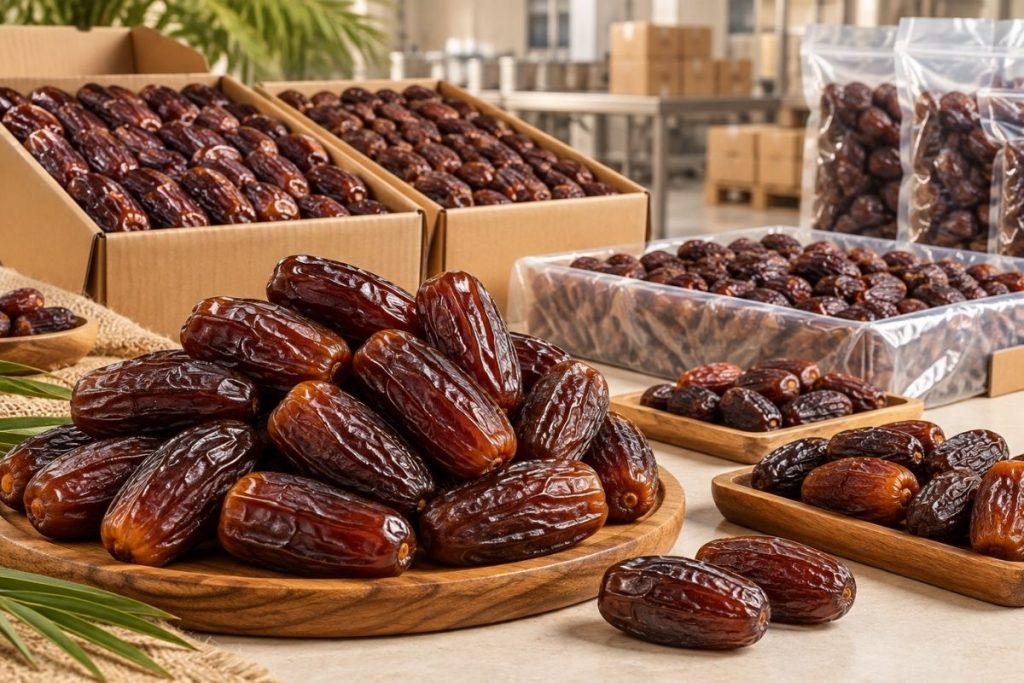
Finding the right Mariami dates supplier involves much more than comparing a price per kilogram. For wholesalers, importers, supermarket distributors, food-service companies and private-label buyers, successful sourcing depends on understanding exactly what is being offered: the grade, fruit size, consistency, packing format, minimum order quantity, quality specifications and commercial terms.
Mariami dates are valued in international wholesale markets for their elongated appearance, dark color, pleasant sweetness and characteristically chewy, semi-dry texture. Their presentation makes them suitable for both everyday retail and more premium positioning, while their relatively firm handling characteristics can make them attractive for international distribution.
However, terms such as Jumbo, Premium, AAA, AA, Grade A and Normal are not necessarily identical from one supplier to another. Two suppliers may describe their product as “Premium Mariami” while supplying noticeably different fruit sizes and visual quality.
That is why professional B2B procurement should begin with specifications rather than names.
This wholesale guide explains how to evaluate Mariami grades and sizes, choose the right packaging, understand MOQ requirements, compare suppliers more effectively and prepare a clearer request for quotation. For businesses sourcing larger quantities, these details can make the difference between a smooth import program and an expensive misunderstanding.
What Are Mariami Dates?
Mariami dates, also frequently written as Maryami dates, are generally marketed as a premium to upper-mainstream semi-dry date variety. In many international catalogs, buyers may also encounter the commercial names Piarom or Piyarom in connection with Mariami dates.
For an importer, however, spelling is less important than the specification behind the product.
A serious supplier should be able to describe the fruit using measurable characteristics such as size or count, moisture range, appearance, texture, defect tolerance, packing weight and product condition rather than relying only on descriptive terms such as “premium.”
The elongated shape and dark appearance of good-quality Mariami dates provide strong shelf presentation. Their semi-dry character also makes them suitable for a range of channels, including supermarkets, traditional wholesale markets, dry-fruit retailers, hospitality, gifting, e-commerce and repacking businesses.
They can be supplied in bulk for repacking or in consumer-ready formats depending on the buyer’s business model.
For this reason, choosing a Mariami dates supplier should start with understanding the final application.
A wholesaler supplying open-market traders may prioritize competitive pricing and 5 kg or 10 kg cartons. A supermarket distributor may care more about uniform size, consumer packaging and label compliance. A premium gifting company may prioritize appearance and larger fruit. A private-label importer may require customized cartons, artwork, barcodes and smaller retail units.
The product is the same variety, but the required specification can be very different.
Why Specifications Matter When Buying Mariami Dates Wholesale
Wholesale dates are agricultural products. Natural differences occur between harvests, farms, production lots and individual fruits. Commercial grading and sorting are therefore essential.
International date standards provide useful frameworks for quality control. UNECE’s current DDP-08 standard covers commercial quality requirements for dates and includes classifications such as Extra, Class I and Class II, together with provisions covering tolerances, uniformity and packaging. It states, among other requirements, that packages should be sufficiently uniform and that dates should be packed in a way that properly protects the product.
However, the A, AA, AAA, Premium and Jumbo terminology often used commercially for Mariami dates should not automatically be treated as equivalent to those official classifications.
Commercial grade names can be supplier-specific.
This creates one of the most important rules in wholesale date purchasing:
Never purchase purely on the grade name. Purchase against an agreed specification.
A buyer comparing “AAA” from Supplier A with “AAA” from Supplier B may otherwise be comparing different products.
The better question is not simply, “What is your best grade?”
It is:
“What are the measurable specifications of this grade?”
Mariami Dates Supplier Grades: What Do A, AA and AAA Actually Mean?
Wholesale Mariami dates are frequently marketed under commercial designations such as Grade A, AA, AAA, Premium, Jumbo, Select or Standard. These labels are useful for separating products within one supplier’s range, but they do not create a universal international grading system.
One seller may use AAA for its largest premium selection. Another may use Jumbo. Another may combine descriptions such as “AAA VIP.” Commercial listings currently show several different systems, demonstrating why buyers should request specifications rather than assuming equivalence between grade names.
A practical interpretation may look like this:
| Commercial Description | Typical Positioning | What the Buyer Should Verify |
| Jumbo / Premium | Highest visual selection | Fruit count, size consistency, defects, skin condition |
| AAA / AA | Premium or upper commercial | Exact supplier specification and sample |
| A / Standard | Mainstream wholesale | Size range, appearance and defect tolerance |
| B / Economy | Price-sensitive channels | Smaller fruit and allowable visual variation |
This table should be treated as a buying framework rather than a universal grading standard.
Grade Is More Than Fruit Size
Large fruit does not automatically mean excellent quality.
A proper grade specification should also consider appearance, ripeness, uniformity, texture, cleanliness, skin condition, physical damage, pest damage, foreign material and consistency across the carton.
For premium retail, buyers generally want strong visual uniformity. Customers should not open a package containing attractive large dates on top and significantly smaller or poorer fruit underneath.
This principle is reflected in UNECE packaging provisions, which state that the visible portion of a package should be representative of the entire contents.
For wholesale buyers, consistency can therefore be more valuable than simply buying the largest available fruit.
A slightly smaller but highly uniform product may perform better at retail than a mixed-size carton marketed as Jumbo.
Understanding Mariami Date Sizes
Size terminology is another area where importers should be careful.
Words such as Jumbo, Large, Medium and Normal can sound precise, but unless the supplier provides a measurable definition, they are subjective.
The most useful method for wholesale comparison is usually fruit count per kilogram or another clearly defined size measurement.
For example, some commercial Mariami/Piarom offers describe approximately 120 dates per kilogram as Jumbo and approximately 150 dates per kilogram as Normal. Other suppliers may use entirely different grade terminology.
This is why the count should appear on the product specification whenever size materially affects the deal.
Count per Kilogram Is Better Than “Large”
Suppose two quotations arrive:
Supplier A offers “Premium Large Mariami Dates.”
Supplier B offers “Mariami Dates – approximately 120 pieces/kg.”
Supplier B has given you significantly more measurable information.
Even better would be a specification describing a permissible count range, because natural products should not be expected to match one exact number in every kilogram.
International standards can also provide useful reference points. The Codex Standard for Dates has an optional general size classification for unpitted dates based on the number of fruits per 500 grams: fewer than 80 is categorized as Large, 80–100 as Medium, and more than 100 as Small. These are generic Codex date classifications rather than a Mariami-specific commercial grading system, but they demonstrate why count-based specifications are preferable to subjective descriptions.
When comparing quotations from different suppliers, normalize them.
If one quote uses pieces per kilogram, another uses pieces per 500 grams, and a third gives only fruit length, ask each company to provide the same measurement.
Only then can price comparisons become meaningful.
Size vs. Grade: They Are Not the Same Thing
Wholesale buyers sometimes use “size” and “grade” interchangeably. They should be treated separately.
Size describes dimensions, weight or fruit count.
Grade describes the broader quality classification of the product.
A large date can still have cosmetic problems or inconsistent texture. Likewise, a smaller fruit can still be exceptionally clean, uniform and commercially attractive.
For a supermarket program, the ideal specification might therefore be a particular count range combined with strict visual requirements.
For an economy wholesale market, a buyer may accept smaller fruit and wider cosmetic tolerances in exchange for a more competitive landed cost.
This distinction should be discussed with the Mariami dates supplier before confirming an order.
Mariami Dates Packaging for Wholesale Buyers
Packaging influences far more than appearance.
It affects product protection, logistics cost, warehouse handling, shelf presentation, private-label potential and final selling price.
A professional sourcing decision should therefore evaluate packaging at the same time as grade and fruit size.
Commercial Mariami offers commonly include bulk cartons in formats such as 5 kg and 10 kg, while various suppliers also offer consumer or private-label formats such as 250 g, 500 g and 1 kg. Larger wholesale cartons and customized formats may also be available depending on the supplier and quantity.
Bulk Cartons
Bulk cartons are often the most efficient solution for importers supplying wholesalers, food service or local repacking operations.
A 5 kg or 10 kg format can reduce packaging cost per kilogram compared with individually packed consumer products.
Bulk packaging can also provide the importer with greater flexibility. Dates can be redistributed to retailers, repacked locally into smaller consumer sizes, incorporated into gift boxes or sold directly to wholesale customers.
The important issue is not simply carton weight. Buyers should confirm the type of internal protection used, net versus gross weight, carton strength, pallet configuration where applicable and how the product is protected against compression or movement during transport.
Retail-Ready Packaging
Importers supplying supermarkets or online retail channels may prefer retail-ready packages.
Common formats may include 250 g, 500 g and 1 kg packs. Depending on the target market, dates may be supplied in trays, boxes, sealed packs or vacuum-style packaging.
Retail packaging creates additional requirements.
Label design, language, product identification, nutrition information where applicable, date marking, barcode requirements, country-specific food regulations and importer information may all need to be considered.
The Codex General Standard for the Labelling of Prepackaged Foods provides an international framework covering food labelling and concepts such as product identification and date marking, although importers must still comply with the specific rules of their destination market.
Private-Label Mariami Dates
Private labeling can significantly increase the commercial value of imported dates.
Instead of selling only a commodity, the importer can create a branded retail product and establish a stronger relationship with supermarkets, distributors and consumers.
However, customized packaging usually changes the economics of the order.
A supplier may be willing to provide one carton of its standard product, but printing thousands of branded boxes involves artwork preparation, printing setup, packaging inventory and production planning.
For this reason, the MOQ for private-label packaging can be higher than the MOQ for ordinary bulk cartons.
Before asking for private label, prepare information such as desired pack size, expected volume, destination country, preferred packaging format and whether artwork is already available.
This allows the supplier to quote much more accurately.
What Does MOQ Mean When Buying Mariami Dates?
MOQ means Minimum Order Quantity: the smallest quantity a supplier is prepared to sell under a particular commercial arrangement.
There is no universal MOQ for Mariami dates.
The required quantity depends on the supplier, current inventory, grade, packaging, customization, destination and shipping arrangement.
Market examples illustrate how wide that range can be. Some wholesale sellers advertise relatively small orders, while export-oriented suppliers may quote minimums measured in several tonnes or encourage container quantities. One commercial exporter, for example, publishes an MOQ of roughly 1–5 tonnes depending on the shipping method.
This does not mean every importer should order several tonnes.
It means buyers need to distinguish between different kinds of MOQ.
Standard Packaging MOQ vs. Private-Label MOQ
A Mariami dates supplier may actually have several MOQs.
Standard stock in an existing 5 kg carton might have one minimum.
A customized 500 g retail package might have another.
A completely bespoke printed carton could require an even larger production run.
There may also be logistics-related minimums. Technically, a supplier might be willing to sell a small quantity, but shipping that quantity internationally could make the landed cost per kilogram commercially unattractive.
Therefore, always ask for the MOQ associated with the exact packaging option you want.
Asking only “What is your MOQ?” may produce an incomplete answer.
A better RFQ says:
“Please quote your MOQ for standard bulk cartons and separately quote the MOQ for our own private-label 500 g retail packaging.”
That immediately gives the Mariami dates supplier enough information to offer realistic alternatives.
Trial Orders vs. Commercial Orders
New importer-supplier relationships often benefit from a staged approach.
A buyer may initially want samples for product evaluation, followed by a smaller commercial test and then a larger recurring program once sales performance has been established.
Whether this is commercially practical depends on freight economics.
For nearby markets, smaller shipments may be workable. For distant destinations, the freight cost and customs process can make small trial quantities relatively expensive.
Instead of comparing only FOB or ex-warehouse prices, calculate the landed cost per kilogram.
This includes the product, packaging, inland transport where applicable, freight, insurance where applicable, customs-related costs and destination handling.
A low product price can quickly become less attractive if logistics are inefficient.
How Packaging Changes Your MOQ
MOQ and packaging are directly connected.
Imagine an importer requires 500 kg.
If the product is available in standard 5 kg cartons, the supplier may already have suitable packaging in stock.
If those same 500 kg need to be packed into 1,000 customized 500 g boxes with a newly printed brand design, the packaging manufacturer may have a minimum printing run greater than 1,000 units.
The dates themselves are not necessarily causing the MOQ problem. The packaging is.
This is common across private-label food products.
For buyers entering a new market, one solution can be to begin with standardized supplier packaging or a simpler labeling approach where permitted, validate demand and move to fully customized packaging when order volumes become large enough.
How to Compare Prices From Different Mariami Dates Suppliers
A wholesale quotation has little meaning unless the products being compared are genuinely comparable.
One supplier might quote a low price for smaller standard fruit in 10 kg bulk cartons.
Another may quote larger fruit with stricter sorting in 500 g retail packs.
Comparing the two prices per kilogram without adjusting for quality and packaging would be misleading.
A more useful comparison looks at the whole specification.
| Comparison Factor | Supplier A | Supplier B | Supplier C |
| Commercial Grade | |||
| Count / kg | |||
| Moisture Specification | |||
| Pitted / Unpitted | |||
| Net Pack Weight | |||
| Packaging Type | |||
| Private Label | |||
| MOQ | |||
| Incoterm | |||
| Lead Time | |||
| Price / kg | |||
| Estimated Landed Cost |
Using a comparison table like this immediately exposes quotations that appear cheap simply because the specification is lower.
What Determines Wholesale Mariami Date Prices?
Mariami date pricing is influenced by several variables simultaneously.
Grade and fruit size are obvious factors, but they are not the only ones. Harvest conditions, available inventory, sorting requirements, order quantity, packaging materials, private-label customization, freight rates and commercial terms can all influence the quotation.
Premium-size products require more selective sorting. If only a proportion of a crop matches a specific large-fruit specification, that selection normally carries a higher value than a broader standard grade.
Packaging can add another significant difference.
The cost structure of dates supplied in a straightforward bulk carton is very different from retail-ready product requiring individual containers, labels, printed cartons and specialized packing.
Order size also influences negotiation.
A regular importer purchasing commercial volumes creates different production and planning efficiencies compared with a one-time small order.
Therefore, professional buyers should avoid asking only:
“How much are Mariami dates per kilogram?”
Instead, specify the product first.
How to Choose a Reliable Mariami Dates Supplier
Price should be one part of supplier selection, not the entire decision.
For an importer, delays, inconsistent batches, incorrect packaging or unclear specifications can cost substantially more than a small difference in purchase price.
A reliable Mariami dates supplier should be able to communicate clearly about the product before asking the buyer to commit.
Product photographs are helpful, but they are not enough. Buyers handling significant volumes should request current product specifications and, where commercially appropriate, representative samples.
The supplier should also clearly state whether images and samples represent the same grade that will be supplied commercially.
The quotation should identify the agreed pack size, quantity, unit price and applicable Incoterm.
For repeat business, batch consistency becomes particularly important.
An importer building supermarket distribution cannot easily explain why one shipment contains noticeably larger or darker dates than the next shipment if both were purchased under the same specification.
This is why specification-based procurement supports long-term trading relationships.
Important Quality Factors for Wholesale Mariami Dates
Dates intended for direct consumption should be sound, properly prepared and protected from contamination and significant defects.
UNECE’s DDP-08 standard establishes minimum quality requirements and permitted defect tolerances for commercial dates, while the Codex Standard for Dates also covers factors including maturity, cleanliness, insects, moisture, minimum sizing and other quality considerations.
Importers should convert these general principles into practical purchase specifications.
Appearance should be reasonably consistent with the selected grade. Fruit should show the expected color and shape of the commercial variety. Buyers should agree on acceptable defect limits, particularly when purchasing products intended for high-visibility retail packaging.
Texture is also important.
Mariami is generally purchased for its characteristic chewy, semi-dry eating experience. Product that is excessively hard, damaged or otherwise outside the buyer’s expected condition may perform poorly even if the fruits are visually attractive.
For larger programs, pre-shipment inspection or agreed quality-control procedures can provide additional protection.
Storage and International Logistics
Semi-dry dates are generally more suitable for storage and distribution than high-moisture date varieties, but that does not mean storage conditions can be ignored.
Excessive heat, direct sunlight, humidity and unsuitable warehouse conditions can affect product quality.
The correct handling method should be based on the supplier’s product specification, packaging, shelf-life documentation and destination requirements.
Commercial sources currently advertise Mariami/Piarom dates in dry-container applications and various bulk export formats, but actual transportation requirements should always be confirmed for the specific product, season, route and destination.
Importers should also consider the entire logistics journey rather than only the ocean or road transport period.
Product may spend time at the supplier’s warehouse, export terminal, port, destination customs area, distributor warehouse and retailer before reaching the consumer.
Good packaging and logistics planning should protect the product throughout that entire process.
Bulk Mariami Dates for Wholesalers and Distributors
Wholesale distributors often require a different product configuration from retailers.
Large cartons can simplify warehouse handling and allow wholesalers to break quantities according to customer demand.
The priority may be dependable commercial quality, competitive price and consistent replenishment rather than elaborate consumer packaging.
In this channel, carton construction matters because packages can be stacked, moved between warehouses and handled several times before reaching the final retailer.
A wholesaler planning recurring orders should discuss supply continuity with the Mariami dates supplier rather than evaluating only the first shipment.
Long-term procurement becomes easier when both parties agree on a repeatable specification.
Mariami Dates for Supermarkets and Retail Chains
Retail-chain buyers generally face additional requirements.
The product must not only taste good; it needs to perform visually on the shelf.
Fruit size consistency, packaging presentation, net weight, branding, barcodes, labeling and carton dimensions can influence whether a product works for a particular retailer.
Smaller consumer units such as 250 g or 500 g can suit premium positioning or trial purchases, while larger packs may offer stronger consumer value.
There is no universally correct retail pack size.
The best format depends on local customer behavior, retail price points, competing products and distribution strategy.
Importers should therefore select the packaging based on their market rather than simply accepting whatever pack happens to be available.
Mariami Dates for Private-Label Buyers
Private-label programs require more preparation but can create stronger differentiation.
An importer may want to specify its own brand, pack size, artwork, carton design and retail positioning.
Before production begins, technical and commercial approvals should be documented carefully.
Packaging dimensions and materials should be confirmed. Artwork should be finalized. Required languages and statutory information should be reviewed. Barcode responsibility should be clear. Product grade and count specifications should be documented separately from the packaging specification.
This is especially important because packaging approval does not automatically equal product approval.
Both need to be correct.
When contacting a Mariami dates supplier for private-label production, sending a structured brief usually produces a faster and more useful quotation.
The Best RFQ Format for Mariami Dates
The quality of the quotation often depends on the quality of the inquiry.
A message saying “Please send your best Mariami price” forces the supplier to guess almost everything.
A professional request should instead include the essential commercial requirements:
- Product: Mariami dates; preferred grade or quality positioning; desired count/size if known; pitted or unpitted; required quantity; bulk or retail packaging; individual pack weight; private-label requirement; destination country and city/port; requested Incoterm; preferred shipping period; and any specific quality, labeling or documentation requirements.
That single briefing dramatically reduces unnecessary back-and-forth.
It also allows multiple suppliers to quote against similar requirements, making comparison easier.
Questions to Ask Your Mariami Dates Supplier Before Ordering
Is Your Grade Definition Written Down?
Ask for specifications rather than accepting only “AAA,” “Premium” or “Jumbo.”
The supplier should be able to explain what distinguishes one grade from another.
What Is the Approximate Fruit Count?
When size matters, ask for count per kilogram or an equivalent measurable range.
This is far clearer than adjectives alone.
Can You Provide a Representative Sample?
For meaningful commercial orders, a sample can help buyers evaluate appearance, texture and size before confirming production.
The buyer should clarify that the commercial shipment is expected to correspond to the approved specification.
What Packaging Formats Are Available?
Ask separately about bulk cartons, retail packs and private-label options.
Do not assume that all grades are available in every packaging format.
What Is the MOQ for Each Packaging Option?
Standard cartons and customized consumer packs may have substantially different minimums.
What Is the Lead Time?
MOQ means little if the supplier cannot meet your required shipment schedule.
Ask when the goods can realistically be prepared and dispatched.
What Trade Term Is Being Quoted?
EXW, FOB, CFR and CIF quotations represent different cost responsibilities.
Compare prices only after understanding what each quotation includes.
What Documents Can Be Provided?
Document requirements vary by destination and transaction. Importers should communicate their requirements early rather than discovering missing paperwork immediately before shipment.
Why UAE-Based Trading Relationships Can Benefit B2B Buyers
For importers across the GCC and international markets, working through an experienced UAE trading company can provide a practical commercial point of contact between product sourcing and overseas procurement.
B2B buyers generally require more than a product catalog. They need timely communication, clear specifications, commercially workable quantities, suitable packaging options and professional execution of the transaction.
Shahin International Trading brings 40 years of trading experience to these relationships and works with serious B2B buyers seeking dependable dates supply.
For Mariami dates inquiries, buyers can discuss the target grade, packaging format, intended market and expected quantity with Shahin’s trade team before requesting a quotation.
This is particularly valuable when an importer is uncertain whether it needs Jumbo or standard fruit, bulk cartons or retail packaging, or a smaller initial shipment versus a larger recurring supply program.
The objective should not simply be to sell a carton of dates.
It should be to establish the right product specification for the buyer’s market.
How Shahin International Trading Approaches Mariami Dates Supply
For B2B procurement, clarity should come before price negotiation.
A quotation is much more useful when both sides know the required grade, size, packing configuration, quantity and destination.
Shahin’s approach is therefore suited to importers, distributors and dates traders who want to discuss their commercial requirements rather than purchase an undefined product purely on price.
Buyers can request available specifications, discuss packaging options and provide expected volumes before receiving the appropriate commercial proposal.
For companies searching for a Mariami dates supplier, this specification-led approach can help reduce misunderstandings and create a stronger foundation for repeat business.
[Internal Link: Mariami Dates / Dates Products Page]
[Internal Link: Shahin International Trading – About Us]
[Internal Link: Request a Quote / Contact Shahin]
Frequently Asked Questions About Wholesale Mariami Dates
What is the difference between Mariami and Maryami dates?
Mariami and Maryami are commonly used alternative English spellings in international date trading. Commercial catalogs may also associate Mariami with names such as Piarom or Piyarom. B2B buyers should confirm the precise product description and specification rather than relying entirely on naming conventions.
What is the best Mariami date grade?
There is no single best grade for every buyer. Premium large fruit may be preferable for gifting and high-end retail, while standard commercial grades can provide better economics for high-volume distribution. The best choice depends on target selling price, customer expectations and intended channel.
Are AAA Mariami dates always better than AA?
Not necessarily across different suppliers. AAA and AA are frequently commercial grade names rather than universally standardized definitions. An AAA product from one seller should therefore not automatically be considered superior to an AA product from another seller without comparing specifications and samples.
What size are Jumbo Mariami dates?
The word Jumbo is supplier-dependent. Some commercial listings use approximately 120 dates per kilogram for Jumbo products, but buyers should not treat that number as a universal standard. Always request the supplier’s actual fruit-count specification.
What packaging is available for wholesale Mariami dates?
Common commercial options include larger bulk cartons and smaller consumer packs. Current supplier offerings show formats including 250 g, 500 g, 1 kg, 5 kg and 10 kg, while other bulk or customized configurations may be available depending on volume and supplier capability.
What is the MOQ for wholesale Mariami dates?
There is no standard MOQ. Minimum quantities depend on supplier inventory, grade, packaging, private-label requirements and shipping method. Bulk product in standard packaging can often have different minimums from fully customized retail packs.
Can Mariami dates be supplied under a private label?
Private-label production may be possible depending on order volume and supplier capability. Buyers should provide the desired pack size, packaging style, artwork requirements, quantity and destination-market labeling requirements when requesting a quotation.
How should I compare Mariami dates quotations?
Compare the same grade specification, fruit count, net packaging weight, MOQ, trade term, quality requirements and destination logistics. A lower price per kilogram is not necessarily cheaper when fruit quality, packaging or freight differs.
Wholesale Mariami Dates Buyer Checklist
Before issuing a purchase order, review the agreed fruit variety, commercial grade, count or size specification, quality requirements, pitted/unpitted format, net weight, packaging type, private-label artwork if applicable, quantity, MOQ, unit price, Incoterm, production lead time, shipment window, required documents, destination requirements and approved sample or product specification.
A clear purchasing specification protects both buyer and supplier.
Final Thoughts: Choose a Mariami Dates Supplier Based on Specifications, Not Just Price
Wholesale Mariami sourcing becomes much easier when buyers stop treating dates as a single standardized commodity.
Grade matters.
Size matters.
Packaging matters.
MOQ matters.
And most importantly, the definition behind each of those terms matters.
Terms such as Jumbo, Premium, AAA and Grade A can help categorize products, but they should never replace measurable specifications. Importers should establish the required fruit size, expected quality level, packaging format, order quantity and destination requirements before comparing quotations.
The best Mariami dates supplier is therefore not necessarily the company offering the lowest headline price.
It is the trading partner that can provide the right product for your market, communicate its specifications clearly and structure the supply around your commercial requirements.
For wholesalers, dates traders, supermarket distributors, private-label businesses and other professional buyers, Shahin International Trading can discuss Mariami date specifications, quantities and packaging requirements and prepare a quotation based on the intended market.
Request Mariami Dates Specifications & Wholesale Pricing
Planning your next Mariami dates order?
Send Shahin International Trading your required quantity, destination, preferred packaging and target product specification.